
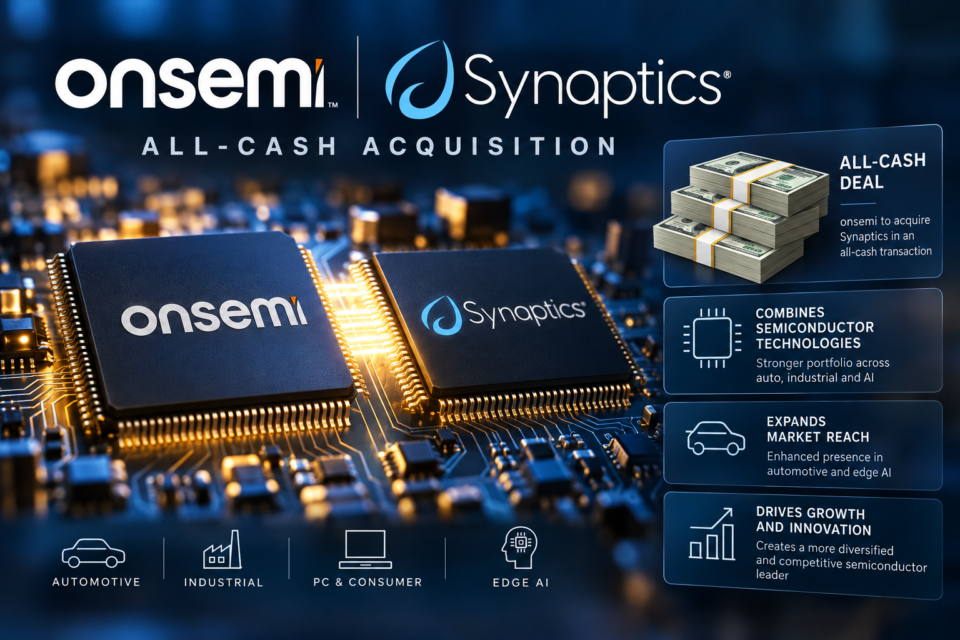
The onsemi Synaptics deal now stands at about $123 per share for Synaptics, replacing the all-stock structure announced in June. The change followed an unsolicited competing proposal from an unnamed third party.
What Happened
onsemi and Synaptics said they amended the agreement they signed on June 25, 2026. The original transaction valued Synaptics at about $5.7 billion.
The companies said the amendment followed a review of the rival proposal. They did not identify the bidder or disclose its terms. The Synaptics board unanimously concluded that the amended agreement remains in the best interests of its shareholders.
Shares of Synaptics jumped roughly 14% in morning trading on Friday. Shares of onsemi rose between about 4% and 7% over the same period, according to Schwab and TheStreet.
Why the onsemi Synaptics Deal Matters
For onsemi, the new structure changes the economics. The company said the deal should now add to its adjusted earnings per share immediately after closing, which the stock version was not expected to do. Chief executive Hassane El-Khoury called the cash deal more attractive for onsemi shareholders because of its lower total cost.
The revised price is below the roughly $7 billion figure in the original agreement. However, the all-cash structure removes any exposure to onsemi’s share price after signing.
For Synaptics shareholders, cash offers certainty. Chief executive Rahul Patel said the all-cash structure provides value certainty at a meaningful premium to the current value of the company.
The deal also keeps onsemi’s strategic plan intact. Management has said Synaptics fits its push into AI data centers, and brings profitable human-machine interface and sensing products with predictable cash flow.
Key Details
● New price: $5.7 billion in total
● Previous terms: All-stock, roughly $7 billion enterprise value, 1.350 onsemi shares per Synaptics share
● Financing: Cash on hand plus fully committed debt financing from Morgan Stanley; the amended agreement has no financing condition
● Synergies: The previously announced $200 million of annual run-rate savings stands; onsemi sees extra revenue synergies and some insourcing of Synaptics production after the first 18 months
● Regulation: The Federal Trade Commission has approved the deal, the companies said, while regulators in other jurisdictions continue to review it
● Timing: Closing is still expected by mid-2027
The two companies serve different corners of the chip market. onsemi, based in Scottsdale, Arizona, and part of the S&P 500, supplies power and sensing technology for automotive, industrial and AI data center customers. Synaptics, based in San Jose, California, focuses on AI at the edge. Its Astra platform combines embedded compute with wireless connectivity and sensing, and its products cover touch, display, biometrics, audio, speech and security processing.
The original June agreement carried a premium of about 19% to recent average prices. It would have left Synaptics shareholders with about 12% of the combined company.
Broader Context
The original announcement pitched the combination as a bet on what the companies call physical AI. They said it could lift onsemi’s addressable market by $243 billion, by 2030. Synaptics brings an edge-AI computing platform, wireless connectivity and sensing products to onsemi’s power and sensor businesses.
Investors reacted sharply to that first structure. RTTNews reported that onsemi shares fell more than 20% in trading after the June announcement. The new cash structure removes share issuance from the deal and reduces the headline price, though it adds borrowing.
Chip dealmaking has stayed active as AI spending lifts demand across the sector. Friday’s market reports also showed strength in AI-linked stocks, with Nvidia reaching a record high.
What Happens Next
The transaction still needs approval from Synaptics shareholders and clearance from remaining regulators. Both companies expect to close by mid-2027.
Synaptics will file a proxy statement with the Securities and Exchange Commission for the shareholder vote, and the companies urged investors to read it when it becomes available. Such documents typically describe how a deal came together, so it may shed light on the rival approach.
The unnamed third party could still matter. The companies have not said whether the rival proposal remains open. Investors will watch for filings that describe the competing approach in more detail, along with any change in Synaptics shareholder support.
