
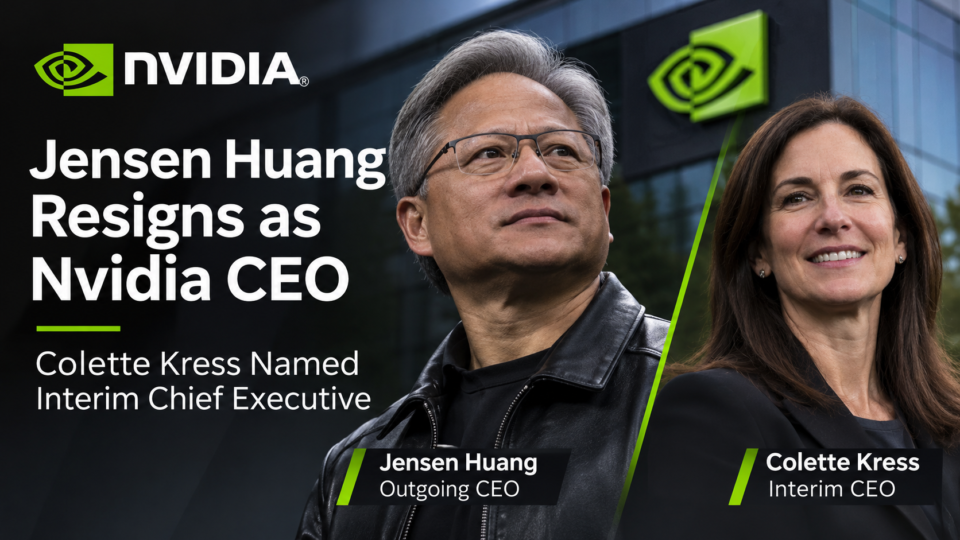
Jensen Huang resigns from Nvidia after 33 years as chief executive, the company announced on Thursday, abruptly ending the tenure of the co-founder who turned a graphics-chip maker into the centrepiece of the artificial intelligence boom. Nvidia said Huang has also left his posts as president and as a board member, effective immediately. Chief Financial Officer Colette Kress will serve as interim CEO while directors search for a permanent successor.
Nvidia shares fell sharply as the news broke, and the shock spread across AI-linked stocks.
What Happened
Nvidia disclosed the change in a press release and a Form 8-K filing dated November 12, 2026. The board said it has begun a search for a permanent chief executive and will weigh internal and external candidates. It also appointed Harvey C. Jones as the company’s first-ever chair of the board.
Kress keeps her role as CFO while she serves as interim chief executive. She joined Nvidia in September 2013 and spent nearly 25 years in finance roles at technology companies, including Cisco and Microsoft, before that. In her statement, Kress said she is committed to building on the foundation Huang created.
Huang, 63, co-founded Nvidia in 1993. CNBC reported that he built it into a company worth roughly $4 trillion.
The reports behind the exit
The resignation followed a fast-moving series of reports. The Wall Street Journal reported on Wednesday evening that the board was preparing to remove Huang and could meet as soon as that night. That report came after a separate newspaper story about his relationship with a company executive. Nvidia stock dropped about 7% in after-hours trading on the news, according to a market report published that evening.
Reuters and other outlets have since linked his departure to reports of extramarital relationships, one of them involving a woman suspected of ties to Chinese intelligence. This publication has not independently verified those allegations. Earlier in the week, Newsweek reported, Nvidia had said it was confident Huang would stay on as chief executive.
Why It Matters
Few executives are as closely tied to one industry as Huang was to AI. Nvidia’s processors power much of the world’s AI training and inference work, and its results have become a barometer for technology spending. A sudden change at the top therefore raises questions well beyond one boardroom.
Analysts at Stifel had flagged the risk in a note published before the announcement. With no successor publicly identified, they wrote, investors would focus on who leads the company, on what timeline, on retention of senior leaders and on Nvidia’s export-compliance posture. That last point matters because Nvidia sells advanced chips under US export rules that affect its business in China.
Market commentators described a leadership vacuum. Kathleen Brooks, research director at XTB, told Reuters the departure “leaves the company rudderless”. She added that the AI trade loses its most visible cheerleader.
CNBC reported that Kress’s interim role will likely last only about a year.
Key Details
The early market reaction, as reported by Reuters and CNBC, included the following:
Nvidia shares: Reuters reported a 7.6% drop in early New York trading. CNBC reported a fall of about 10% at one point.
Rivals: Advanced Micro Devices rose 4.3% and Broadcom gained 5.5% in early trading, according to Reuters.
Indexes: About 15 minutes after the open, the S&P 500 was down 0.29% at 7,597.32. The Nasdaq Composite was down 0.56%, and the Dow Jones Industrial Average was up 0.07%.
Sector: The S&P 500 technology index fell 1.3%, and the Philadelphia semiconductor index slipped 1.3%.
Reuters noted that other Big Tech names, including Amazon, traded higher, which limited the damage to the broader market.
Broader Context
The leadership shock arrives at a delicate moment for AI-related stocks. On November 5, the Associated Press reported a sell-off in shares tied to the AI data-centre buildout that pushed the S&P 500 to its worst day since the tariff turmoil of 2025. A rebound followed on Wednesday, helped by strong results from cloud provider CoreWeave.
Thursday’s moves threatened to wipe out part of that recovery. Nebius, another AI cloud company, also cut its revenue outlook on the same day, adding to pressure on the sector.
Nvidia’s succession planning had drawn attention before. Huang said at CES that he planned to stay “for as long as I deserve it”, and the company had not announced a formal successor. The board now faces the task of finding a leader for a company whose valuation depends heavily on confidence in its direction.
What Happens After Jensen Huang Resigns
The immediate focus is the board’s search. Directors have said they will consider internal and external candidates, and Kress will run the company day to day in the meantime. The announcement, as reported, did not set a public deadline for naming a permanent chief executive.
Investors will look for signs of continuity in product roadmaps, customer relationships and supply agreements. They will also watch for any further departures among senior leaders, which analysts have named as a risk. Questions about export compliance and the company’s dealings in China are likely to stay in view while the allegations circulate.
Nvidia’s next quarterly report will offer the first detailed look at how management intends to steer the business through the transition. Until then, markets are likely to treat each new report about the board’s deliberations as a potential catalyst.
