
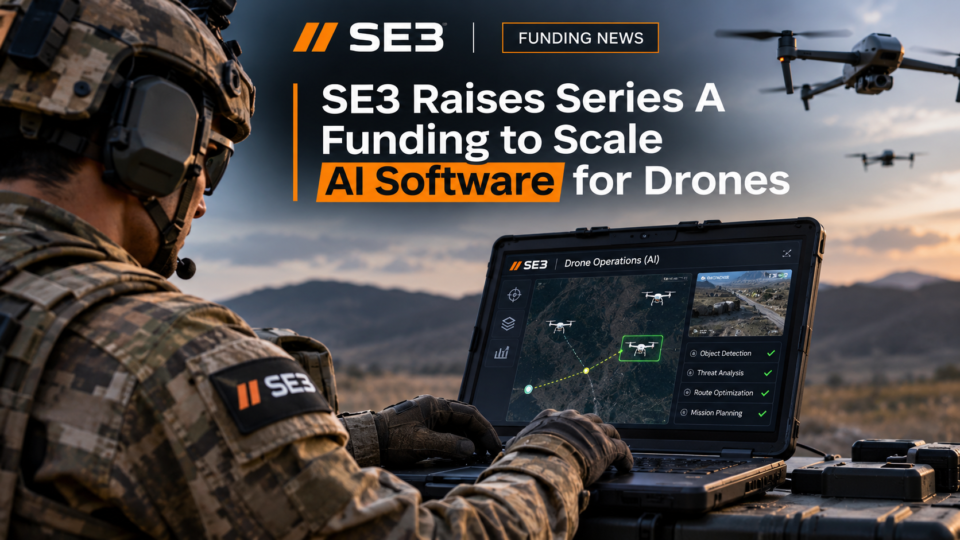
The SE3 Series A has closed at $30 million, giving the Munich-based defence-technology startup fresh capital to build AI software for military drones and other unmanned systems. Accel led the round, Fortune reported on Thursday. Keen, Lakestar and Seedcamp also took part.
The financing comes less than five months after SE3 emerged from stealth with €5.5 million ($6.1 million) in seed funding.
What Happened
SE3 makes software that helps drones and ground vehicles understand the three-dimensional world around them. The company recently dropped “Labs” from its name. Its chief executive and co-founder, Lukas Köstler, previously worked on Tesla’s Autopilot team and at Nvidia Research.
The new funding will let SE3 grow from about 40 employees to roughly 120. It plans to open offices in London, Berlin, the Nordics and Baltics, and Poland, Köstler told Fortune.
Why the SE3 Series A Matters
Europe is spending heavily on defence, and drones have become central to modern warfare. Investors are looking for software companies that can make autonomous systems more capable and easier to coordinate.
SE3 is betting on a specific gap in the market. Köstler argued that if each drone maker controls its own software, customers will struggle to combine systems from different suppliers. Within two or three years, he said, they would face costly lock-in. SE3 wants to sit above individual hardware vendors.
Accel partner Matt Robinson said the team is well placed to build spatial AI for autonomous systems, a task he described as difficult for traditional defence primes.
Key Details
Fortune’s exclusive report outlines how the technology works:
Battlefield map: SE3’s software fuses video and sensor feeds from several drones and ground vehicles into one 3D picture. Köstler compared it to a mini map in a strategy game.
Plain-language commands: A labelling layer lets soldiers ask questions or give orders in natural language. For example, an operator could request reconnaissance two kilometres north over a forest, and a suitable drone would fly the mission and report back.
On-board AI: SE3 also builds the systems that sit inside drones. They help with navigation when GPS is jammed, object detection and swarm behaviour.
Human approval: Actions such as drone takeoff can be set to require an operator’s sign-off.
Offline use: The system can run without a network connection, and customers can swap in their preferred frontier AI model.
How SE3 uses AI
The company does not rely on general-purpose large language models to understand terrain or physics. Instead, it uses classical computer vision to condense sensor data into a database that a language model can query. The model can then call conventional tools. If it needs a flight path, a standard planning algorithm calculates one, avoiding mountains or enemy lines of sight.
Feeding raw data straight to a language model “wouldn’t work at all”, Köstler told Fortune.
Broader Context
SE3 spun out of the computer vision lab of Daniel Cremers at the Technical University of Munich. Köstler and chief technology officer Simon Klenk were doctoral students there, and Cremers serves as chief science officer.
The company has contracts with the German armed forces, the Bundeswehr, to develop its fleet-command software. It has also demonstrated the technology with them. SE3 has contracts in Ukraine, where its technology is already deployed. Its partners include sensor maker Hensoldt, drone software company Auterion and drone developer ERC.
Köstler said the most basic capability, letting drones locate themselves without GPS, has been delivered thousands of times and is very robust. The higher-level fleet command software is less mature. He said much remains to be built over the next one to two years.
As a German company, SE3 operates under strict export laws. Köstler noted that parliament ultimately decides what the company will do. It serves European NATO members and their allies.
The round also highlights an unease in parts of the AI community about military work. Fortune pointed to the Pentagon’s March decision to label Anthropic a supply-chain risk after it refused to allow fully autonomous weapons or mass domestic surveillance uses of its models.
What Happens Next
Defence will remain SE3’s main revenue source for at least the next 12 months, Köstler said. A small team will begin exploring civilian robotics, which could widen the market over time.
The immediate test is delivery. The company must mature its fleet-command software and turn pilot work with the Bundeswehr into larger programmes. Hiring 80 more people in a competitive talent market will also be a challenge.
For investors, the key question is whether SE3’s hardware-neutral approach wins out over vertically integrated drone makers. Its ability to keep partners such as Hensoldt and Auterion on board will help answer it.
