
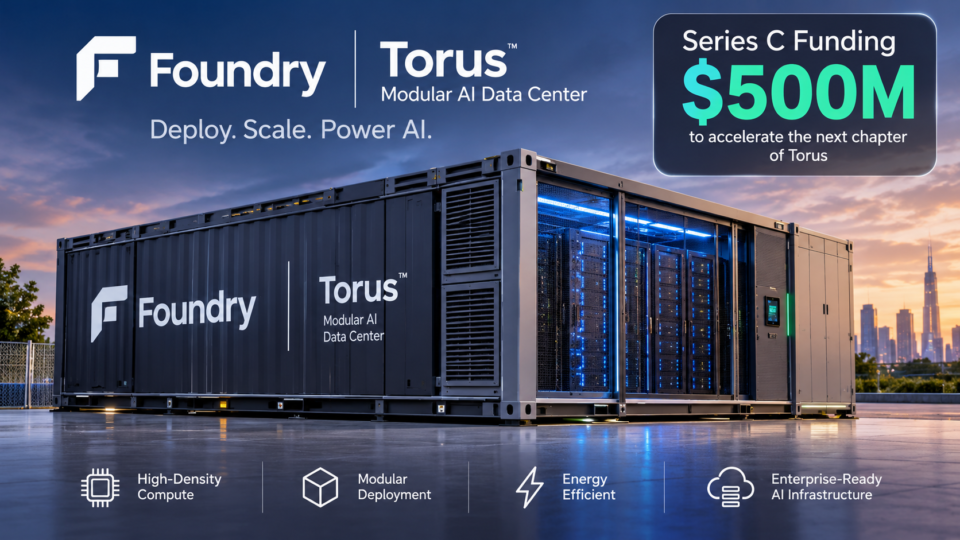
Torus, a Utah energy-storage company, has raised $500 million in a Series C round led by Magnetar. The Torus Series C will fund Foundry, a new shipping-container-sized product that combines batteries with AI computing. Bloomberg reported the funding on Wednesday, citing a company statement.
What Happened in the Torus Series C
Torus said Magnetar led the round, with participation from ICONIQ, Origin Ventures, Ridgeline Partners and Trinity Capital. Bloomberg identified the financing as a Series C. The company will use the money to manufacture Foundry, which it launched on the same day.
Until now, Torus has mainly sold modular battery systems. Businesses and factories use them to manage energy consumption and reduce electricity bills. Foundry marks a move into AI infrastructure, a market where demand for computing capacity is growing quickly.
What Is Foundry?
Foundry is a prefabricated unit that brings power supply, energy storage, cooling, networking and computing together. According to the company’s announcement as relayed by news outlets, each site ranges from one to 20 megawatts. Torus says a site can go from signed contract to operation in roughly 12 to 16 weeks.
The units are designed for AI inference, the stage where trained models answer user requests. They are installed behind the meter at commercial and industrial sites that have unused grid capacity. Torus says its flywheel and battery technology covers demand peaks, so more computing fits on an existing grid connection.
Co-founder and chief executive Nate Walkingshaw told Bloomberg that the idea is to move chips to power that already exists. That approach contrasts with building a large new data center and then waiting for utilities to deliver the electricity.
Who Is Using It
Torus is launching Foundry with Hydra Host, an AI infrastructure company, and another AI cloud provider as first customers. Reporting based on the announcement says the company aims to deploy more than 47,000 GPUs by the end of 2027. That is a company target, not a delivered figure.
Torus builds the product at its GigaOne plant in Salt Lake City. One industry report put the plant at 545,000 square feet, with a line rated for 500 megawatts of IT load and plans to expand to 1 gigawatt. Those figures come from company-linked reporting and have not been independently verified.
Why It Matters
AI data centers face a bottleneck that has little to do with chips. Power delivery and grid connections often take years. Torus argues that modular, factory-built units can reach customers faster. The company also estimates that annual AI inference data-center demand will grow 35% through 2030, which is its own forecast rather than an independent projection.
Magnetar’s managing partner Dave Snyderman said Foundry is about bringing compute to available power. The firm also led Torus’s earlier $200 million investment in September 2025, so this round deepens an existing relationship.
For investors, the deal shows that capital is flowing beyond chips and models into the physical systems that supply AI. It also shows how companies from adjacent industries, such as energy storage, now try to capture part of the AI infrastructure boom.
Broader Context: The Race for AI Power
Cloud providers that rent AI computing capacity are racing to add power. CoreWeave, for example, said on Tuesday that its active power footprint has grown past 1.7 gigawatts, doubling since the start of the year. Demand of that kind explains why investors are backing solutions that shorten build times.
The sector also faces financial pressure. Higher interest rates have raised borrowing costs for infrastructure-heavy companies, and investors are scrutinising how AI buildouts get funded. A startup that offers smaller, faster deployments may appeal to customers who want to avoid very large capital commitments. Whether that holds true will depend on how Foundry performs in the field.
What Happens Next
Torus will now scale manufacturing and begin deliveries to its first Foundry customers. The company’s targets include its 2027 GPU deployment goal and an expansion of factory capacity.
Key questions remain. Customers will want evidence that the units deliver reliable performance and that deployments really take weeks rather than months. Competitors in modular and edge computing will also respond. For now, the Torus Series C shows that investors see a path from battery storage to AI inference.
