
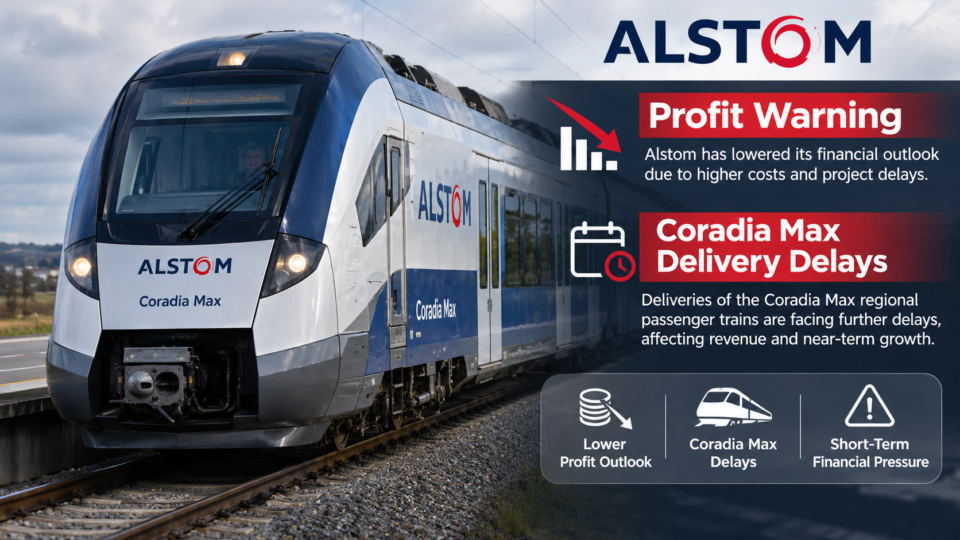
French rail manufacturer Alstom issued its second profit warning of 2026 on Monday. It cut its full-year margin forecast to about 1% and flagged a €1.5 billion cash outflow. The Alstom profit warning, published on 2 November after the board met on 1 November, sent the shares down by more than a quarter in early Paris trading, according to market reports. The group also said it is reviewing options to cut debt by roughly €2 billion by September 2027.
What Happened in the Alstom Profit Warning
Alstom released preliminary, unaudited results for the first half of its 2026/27 fiscal year, which ended on 30 September. The numbers were weak. Adjusted EBIT margin came in at around minus 4%, compared with 6.4% a year earlier.
The company blamed execution problems in Europe, mainly on its Coradia Max regional train platform. It cited industrialisation challenges and a longer approval timeline for the train. Other projects built for, and from, Germany were also affected. Manufacturing on Coradia Max was paused in the first quarter to fix identified issues and limit later retrofit work.
Sales still grew. Group sales reached €9.3 billion, up 3% (2% on an organic basis). Orders rose to €11.0 billion from €10.5 billion, with the second quarter alone bringing in €8.4 billion. Production, however, slipped. Alstom built 1,860 cars in the half, 8% fewer than the 2,017 a year earlier.
Key Details: The New Full-Year Guidance
The revised outlook for the year to 31 March 2027 is sharply lower:
Adjusted EBIT margin: around 1%, down from around 6.5% previously. That implies a rebound to roughly 6.5% in the second half.
Free cash flow: negative €1.5 billion, against a “positive” forecast before.
Car production: around 4,000, versus 4,400 to 4,500 previously.
Organic sales growth: low to mid-single digit, compared with about 5% before.
Book-to-bill ratio: above 1, unchanged.
First-half free cash flow was negative €1.248 billion. Net debt rose to €1.1 billion at 30 September from €0.4 billion at 31 March. Alstom linked the cash drain partly to seasonality. It also pointed to milestone payments shifting into later periods as approval timelines for major projects, including Coradia Max, stretch out.
Why It Matters for Investors and Rail Customers
This is the second time this year Alstom has reset expectations. In April, it withdrew a three-year cumulative free cash flow target of €1.5 billion and said its 8% to 10% margin ambition would not be met by 2026/27. The shares dropped sharply that day as well.
Alstom is one of the world’s largest suppliers of trains and signalling systems. Delays at a major supplier can ripple through operators’ fleet plans and public transport budgets. The company itself now expects later entry into commercial service for several major projects.
For markets, the update raises questions about balance-sheet strength. Alstom says it wants to protect its investment-grade credit rating. At 30 September it held €1.65 billion in cash, and its €2.5 billion revolving credit facility was undrawn. Commercial paper outstanding was nil.
On 1 November, Alstom also signed a new €2.0 billion short-term revolving credit facility with a first-tier international bank. The company says the facility carries no financial covenants and matures in November 2028.
Broader Context: Execution Risk on Long Rail Contracts
Rail manufacturers book profit on multi-year contracts, so problems on one platform can spread. Alstom said strengthened reviews of its most critical rolling-stock projects revealed additional work, longer timelines and knock-on effects elsewhere. Those findings led to revised margins at completion on selected projects.
Chief executive Martin Sion, who took the job in April 2026, said the update reflects a tougher process for flagging project-level risks. He said the aim is to normalise group performance from the next fiscal year. Alstom expects margins to move back towards 8% to 10% over the medium term, starting from 2027/28.
The company has also set “project execution excellence” as its top priority. Measures launched since April include leaner operations, faster issue resolution, tighter accountability for project managers and stronger procurement discipline.
What Happens Next
Alstom has given investors a clear calendar:
17 November 2026: full half-year results.
19 January 2027: third-quarter orders and sales.
Early 2027: decisions on the group’s organisational and operating model.
Second quarter of 2027: a Capital Markets Day with the medium-term financial trajectory.
The board has started a review of organic and inorganic options to reduce debt by around €2 billion by September 2027. It will keep flexibility over the sequencing and size of any measures. Bloomberg reported that the plan could include divestments. Alstom said board-represented shareholders back the company and are working with management on the review. It also expects the project-level risk review to be completed by the end of the fiscal year.
Investors will now focus on one question. Can Alstom deliver the roughly 6.5% second-half margin it has promised after posting a loss-making first half?
