
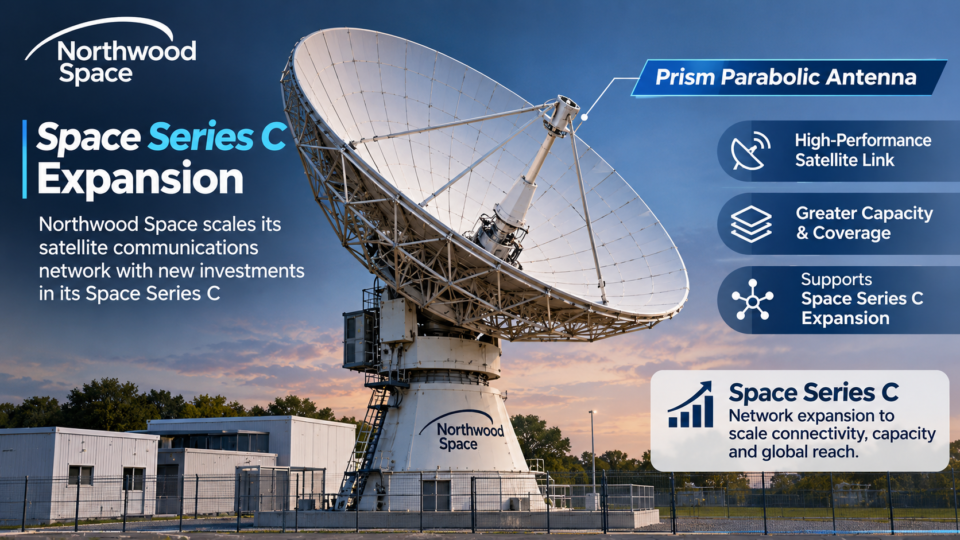
Northwood Space, a US startup building satellite ground stations, has raised $375 million in a Series C round that values the company at $2 billion. The Northwood Space Series C, announced on Monday morning, will fund faster antenna production and a hiring push of 400 people over the next three years. Andreessen Horowitz (a16z) and DFJ Growth co-led the round, according to Via Satellite.
What Happened in the Northwood Space Series C
Northwood announced the $375 million raise on 2 November. It is the company’s second funding round in less than a year. In January, Northwood raised $100 million in a Series B.
Alongside the equity round, the company secured a separate multi-year credit facility from HSBC Innovation Banking. The facility is meant to support working capital and network expansion.
Other investors in the Series C include Alpine Space Ventures, Washington Harbour Partners, Stepstone Activate and In-Q-Tel (IQT), the venture arm often associated with US intelligence-community technology. Other investors were also part of the round.
Key Details: Antennas, Jobs and Production
Northwood builds the ground-side infrastructure that satellites need to send and receive data. The company currently sells two products:
Portal: a phased-array antenna designed for command and control. It can communicate with six satellites.
Prism: a high-throughput parabolic antenna for high data rates. It talks to one satellite at a time.
Over the past year, Northwood built 29 units across both products. It now aims to move from dozens to hundreds. Co-founder and chief executive Bridgit Mendler said the company produced half a dozen dishes in the time a typical antenna vendor takes to return a quote.
To support that ramp-up, Northwood recently opened a 185,000-square-foot production facility in Torrance, California. The site is designed to handle hundreds of antennas in production. The company has 140 employees and plans to add 400 jobs in Torrance and Washington, DC, across RF engineering, manufacturing, software and site operations.
Why It Matters: Ground Networks Are a Space Bottleneck
Satellite constellations get most of the attention, but they are only useful if data can be moved to and from the ground reliably. Mendler compared Northwood’s model to cloud computing. She described a common pool of shared infrastructure that customers can tap rather than building their own stations.
Today’s largest ground networks have hundreds of sites. Northwood says it plans to surpass that scale. Its pitch is aimed at operators of large constellations that need dependable service for commercial or government missions.
Mendler said that when Northwood gets specific with those customers, it typically does not face direct competition. That claim is the company’s view and has not been independently tested. Even so, the size of the round suggests investors see ground capacity as a real constraint.
Speed is another selling point. The company said it fielded a 7.3-metre antenna in a matter of days. Mendler contrasted that with alternatives that can take months or years to deliver the same capacity. Rapid replacement is increasingly relevant for resilience, she said.
Broader Context: Defence Demand and Private Capital
Government interest is a major factor. Earlier this year, Northwood received a $49.8 million contract from the US Space Force to support the Satellite Control Network. That network provides telemetry, tracking and command for Department of Defense satellites. Mendler said the contract uses Portal. She declined to share more about Northwood’s government work but described a “ton” of interest.
The deal also reflects a busy period for space and defence-adjacent funding. Via Satellite’s finance coverage in recent weeks has included Nvidia’s minority investment in German satellite maker Reflex Aerospace and a $30 million Series A for on-orbit security startup Fortastra. Telesat has also pushed full Lightspeed service entry to mid-2028, with its chief executive addressing a launch crunch and sovereign demand.
For venture investors, Northwood sits in an attractive niche. It combines hardware manufacturing, recurring network services and government customers.
What Happens Next
Northwood has outlined its priorities. They are:
Scaling production: moving from 29 units built last year to hundreds of antennas.
Expanding the network: adding sites to surpass the scale of today’s largest ground networks.
Hiring: growing from 140 employees by adding 400 roles over three years.
Government work: continuing its Space Force Satellite Control Network contract.
Via Satellite’s report did not include revenue figures or a timeline for new site openings. Investors will watch how quickly production in Torrance ramps up and whether Northwood can turn that capacity into long-term customer contracts.
