
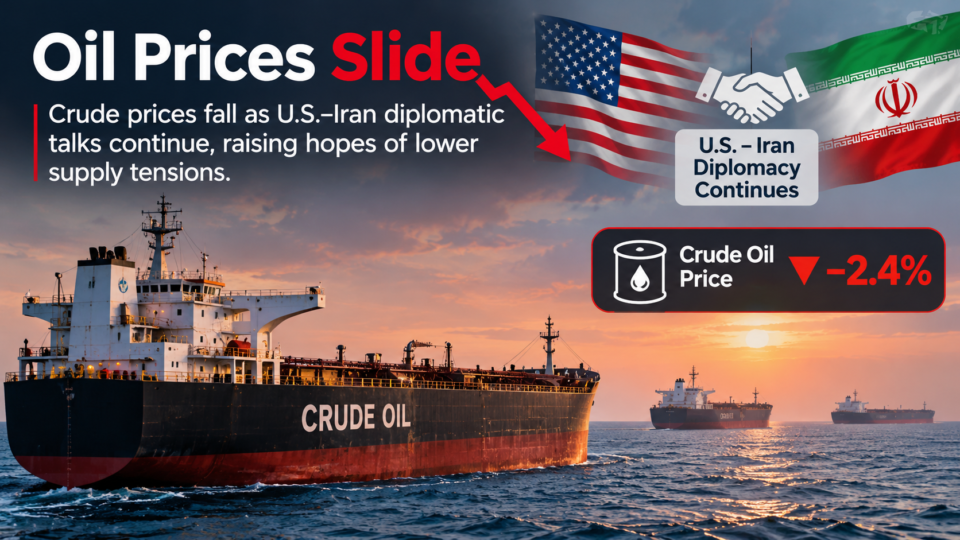
Oil prices slide as hopes grow that Washington and Tehran can still find a diplomatic route out of the conflict that began in March. On Monday, Brent crude fell more than 3% to about $110 a barrel in morning trading, while US benchmark West Texas Intermediate dropped to $100.90, according to The National. The move followed reports that President Donald Trump wants to give diplomacy more time before weighing fresh strikes on Iran.
What Happened to Oil Prices on Monday
Both major benchmarks gave back ground at the start of the week, after climbing to a six-month high last week. Brent was trading near $110 a barrel at 7:55 a.m. UAE time. WTI was around $100.90.
Axios reported that Trump told Israeli Prime Minister Benjamin Netanyahu he wants to give diplomacy with Tehran more time before considering renewed strikes. That decision would come after Tuesday’s US midterm elections.
CBS News reported that Trump said the war would end soon, “one way or the other.” Speaking before a rally in Iowa on Sunday, he said Iran would either make a deal or the US would end it. On Saturday, Secretary of State Marco Rubio said no decision had been made on renewed strikes and that Trump preferred a diplomatic outcome.
A morning market briefing also noted that crude fell overnight on reports that Washington wants more time for Iran diplomacy. US energy shares were the weakest sector in premarket trading.
Why Oil Prices Matter So Much Right Now
Crude at $110 is far above the roughly $72 at which Brent traded before the conflict began, according to Euronews. Higher oil feeds directly into fuel, transport and manufacturing costs. It also complicates the inflation picture for central banks and households.
UBS commodity analyst Giovanni Staunovo said record freight costs, constrained tanker capacity and recovering Chinese imports are likely to keep prices elevated. UBS expects Brent to stay near $110 a barrel at the end of the year.
Key Details: Risk Premium Remains High
Despite Monday’s drop, supply fears have not gone away. The National reported these points:
Weekly move: Brent and WTI both rose about 0.8% over the past week.
Monthly move: Brent gained about 15% in October and WTI about 12%, taking both to their highest levels since April.
Hormuz incidents: the UK Maritime Trade Operations (UKMTO) reported that a ship was struck by a projectile in the Strait of Hormuz on Sunday, after an attack on a liquefied natural gas tanker on Friday.
Gulf coast attack: UKMTO also reported a vessel struck east of Ras Al Khafji, along Saudi Arabia’s coast. Two ships were hit over the weekend.
Fears of US strikes have kept supply risk premiums elevated. That is why traders react quickly to any sign that diplomacy is gaining or losing ground.
Broader Context: Midterms, Earnings and Central Bank Data
Oil is not the only market theme this week. US stock futures edged higher on Monday after a difficult week for Wall Street, with investors preparing for a packed calendar. That includes the midterm elections on 3 November, a heavy run of corporate earnings and key jobs data.
Apple and Palantir report after the closing bell on Monday. Investors will also watch the ISM manufacturing index, a Federal Reserve survey of bank lending standards due at 2 p.m. Eastern, and the US Treasury’s fourth-quarter borrowing figures.
Energy prices sit behind many of those numbers. A sustained fall in crude would ease cost pressure on manufacturers and consumers. A renewed spike could revive concerns about inflation and growth.
What Happens Next
The next steps remain uncertain. An Iranian delegation travelled to Qatar for talks with mediators on Saturday, according to a Bloomberg report cited by The National. No agreement has been announced. Rubio has said no decision on strikes has been taken, and Trump has signalled he prefers diplomacy for now.
Three things will shape oil prices in the coming days:
Diplomacy: any announcement from the Qatar-based mediation or direct contacts.
Shipping security: further attacks on vessels in or near the Strait of Hormuz.
US political timing: Trump’s stated plan to revisit the issue after Tuesday’s vote.
Price levels in this report reflect the figures quoted in The National’s morning coverage and may move through the trading day. Markets are likely to stay volatile until the diplomatic picture becomes clearer.
