
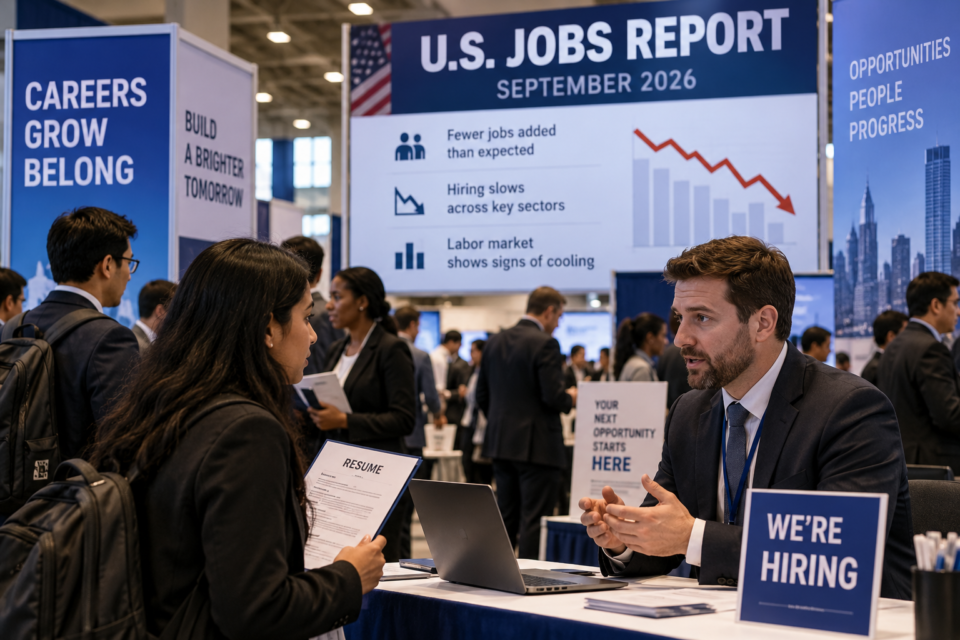
US employers added just 29,000 jobs in September, and the unemployment rate rose to 4.2%, the Bureau of Labor Statistics (BLS) reported on Friday, October 2, 2026. The US jobs report fell far short of forecasts. Economists surveyed by Dow Jones had expected a gain of about 84,000. Even so, Wall Street rallied, because weaker hiring lowers the odds of another Federal Reserve rate increase this month.
What the September US Jobs Report Showed
Nonfarm payrolls rose by 29,000, the BLS said. A Reuters poll had forecast 90,000. Revisions made the picture weaker still. The agency lowered its estimate for August to a gain of 133,000 from 162,000, and July now shows a loss of 10,000 jobs. Together, the revisions to the prior two months removed 60,000 jobs.
The unemployment rate edged up to 4.2% from 4.1%, and 7.1 million people were out of work. The rate has stayed between 4.1% and 4.3% since March. Wage growth also cooled. Average hourly earnings rose 3.1% from a year earlier, the slowest pace in five years, according to HousingWire’s reading of the data.
Economists urged caution about the weak headline figure. Reuters reported that seasonal adjustment quirks probably played a role, because payrolls tend to underperform when Labor Day falls late in the month, as it did this year. Layoffs have also stayed low. First-time claims for unemployment benefits have hovered near 57-year lows.
Why the Jobs Data Matters for the Fed
The report landed at a delicate moment for the central bank. The Fed raised interest rates by 25 basis points in September, and investors have been debating whether it will tighten again at its meeting later this month. Fed officials have said they are more concerned about inflation than about the labor market, CNBC noted ahead of the release.
After Friday’s data, traders scaled back their bets. Reuters reported that market pricing for an October hike fell as low as 12% before settling near 21%.
Analysts largely read the numbers as a reason for the Fed to pause. Brian Jacobsen of Annex Wealth Management called the report a dud and said it supports an October pause. He added that the lack of breadth in hiring now sits alongside the Fed’s worries about broad inflation. Lindsay Rosner of Goldman Sachs Asset Management also considers an October move unlikely. She still sees a December increase as her base case, and she warned that higher energy prices could force the Fed’s hand sooner.
Key Details: How Markets Reacted
Investors responded quickly. Bad news for workers became good news for asset prices.
- Stocks: The S&P 500 opened up 0.9% and the Nasdaq composite rose 1.2%, according to Reuters.
- Bonds: The two-year Treasury yield, which is most sensitive to Fed expectations, fell 3 basis points to 4.758% after dropping as much as 8 basis points. The 10-year yield slipped 3 basis points to 5.205%.
- Currency and gold: The dollar index eased 0.1% to 101.9. Gold gained 0.8% to $4,210.
Several strategists said the rally was broadening. Thomas Hayes of Great Hill Capital argued that buying spread well beyond the small group of stocks that had led the market for two months.
Broader Context: Energy Costs and a Shrinking Labor Supply
Economists expect harder conditions ahead. Reuters reported that high energy prices and strained supply chains tied to the US-Israel war with Iran could begin to disrupt hiring by the end of this year and into 2027.
Labor supply is also tightening. Retirements and the Trump administration’s immigration crackdown are keeping the jobless rate low even as hiring slows, Reuters said. That is one reason some economists see the weak payroll figure as less alarming than it looks.
Christopher Hodge of Natixis noted that the three-month average gain is 51,000 and the yearly average is 41,000. Both are above most estimates of the pace needed to keep unemployment stable. He also pointed to higher participation as a positive factor behind the small rise in joblessness.
The household survey told a stronger story. Gary Schlossberg of Wells Fargo Investment Institute said household employment jumped, but the labor force grew even faster, which pushed the unemployment rate higher. He also noted that wage growth has slowed for three straight months. That trend could squeeze household spending power in the fourth quarter.
Workers themselves sound less confident. A survey cited by CNBC before the release showed worker sentiment near record lows.
What Happens Next
The Fed’s next policy meeting is the immediate test. Most strategists quoted by Reuters expect the central bank to hold in October, while December remains in play for another increase.
Investors will now watch two things. First, upcoming inflation data will show whether higher rates and energy prices are changing the price outlook. Second, later labor reports will show whether September’s downward revisions mark a real trend or a statistical blip. Hayes said the revisions need confirmation before anyone draws firm conclusions.
For policymakers, the balance is tricky. Inflation remains uncomfortably high, yet hiring is cooling and the yield curve has moved closer to inversion, according to Reuters commentary. A further slowdown would intensify the debate over how far the Fed should go.
