
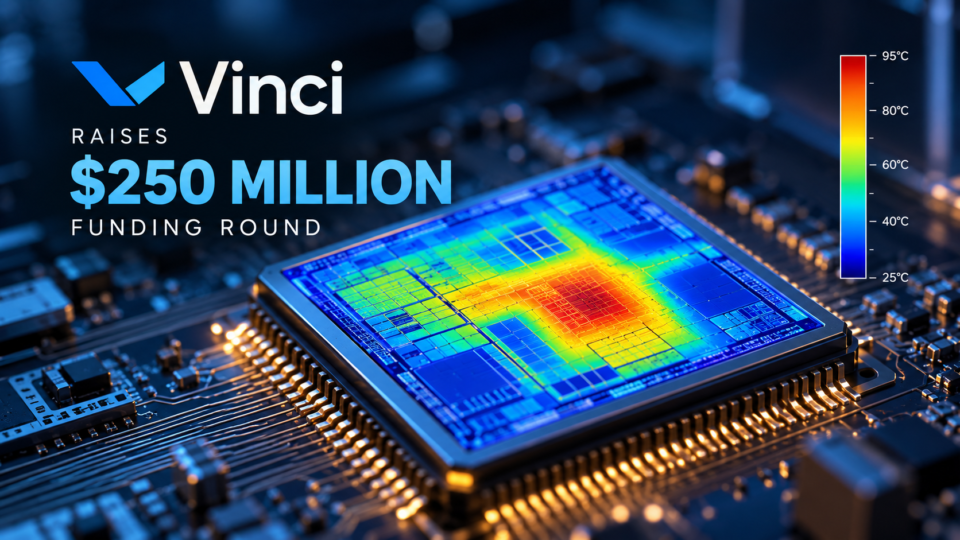
Vinci, a Palo Alto startup that uses artificial intelligence to speed up physics simulation for chip and hardware design, has raised $250 million at a $1.5 billion valuation.
Advent, Temasek and Xora Innovation led the financing. Eclipse, Khosla Ventures and Madrona also took part.
What Happened: Vinci Raises $250 Million
Vinci builds software that simulates how chips and other hardware will behave before they are manufactured. The company started with thermal modeling, a growing problem as AI processors become larger, denser and hotter.
It now plans to expand into full-system simulation, including vibration and electromagnetics. Chief executive Hardik Kabaria told Reuters that Vinci is moving from a handful of pilot deployments toward broader production use.
Why the Round Matters
Chip design relies on deeply embedded engineering software, much of it sold by established companies such as Cadence and Synopsys. Replacing or supplementing those tools is hard, because engineers must trust simulation results before committing large sums to manufacturing.
That difficulty cuts both ways. If Vinci’s models prove accurate enough to become part of production workflows, customers may find them costly to replace. If they fall short, a new tool will struggle to win a place in the design process.
The funding also shows how the AI boom is creating demand for new tools. More advanced AI chips mean more design complexity, which increases the need for faster simulation.
Key Details
● Company: Vinci, headquartered in Palo Alto, California.
● Amount raised: $250 million.
● Valuation: $1.5 billion, according to Reuters.
● Lead investors: Advent, Temasek and Xora Innovation.
● Other investors: Eclipse, Khosla Ventures and Madrona.
● Focus: AI-assisted physics simulation, beginning with thermal analysis.
Vinci emerged from stealth in December 2025 with $36 million Series A led by Xora Innovation and a seed round led by Eclipse. The company was founded in 2023 by Kabaria and Sarah Osentoski.
At that stage, Vinci said its software could run simulations up to 1,000 times faster than conventional tools. It said more than 10 semiconductor companies had benchmarked its results against traditional methods. Those claims came from the company. Kabaria declined at the time to name customers, though he said Vinci was running pilots with several large chip companies.
Broader Context
Venture funding remains heavily concentrated in artificial intelligence. Crunchbase data cited by Tech Startups shows that global startups raised $159 billion in the third quarter of 2026. That is up 53% from a year earlier, though 25% lower than in the second quarter.
AI companies took $1 billion or more, and those companies accounted for roughly one-third of all venture funding in the quarter.
Vinci’s round sits below those mega-deals but shows where investors are looking next. Money is moving toward specialized AI products that tackle costly engineering problems, not only general-purpose models.
Other rounds announced on the same day point the same way. London- and Paris-based Spiko raised $58 million Series A, and Amsterdam’s Hadrian raised $40 million to automate offensive cybersecurity testing.
What Happens Next
Vinci now has capital to move from pilots to wider deployment, which is the stated goal. The company also plans to extend its simulation capabilities beyond thermal analysis.
The next test will be adoption. Chip designers will want evidence that Vinci’s simulations match real-world behavior across more types of hardware. A $1.5 billion valuation raises expectations that the company can turn early interest into long-term contracts with major chipmakers.
Details such as revenue, customer names and the exact split of funding between investors were not part of the reporting reviewed for this article.
