
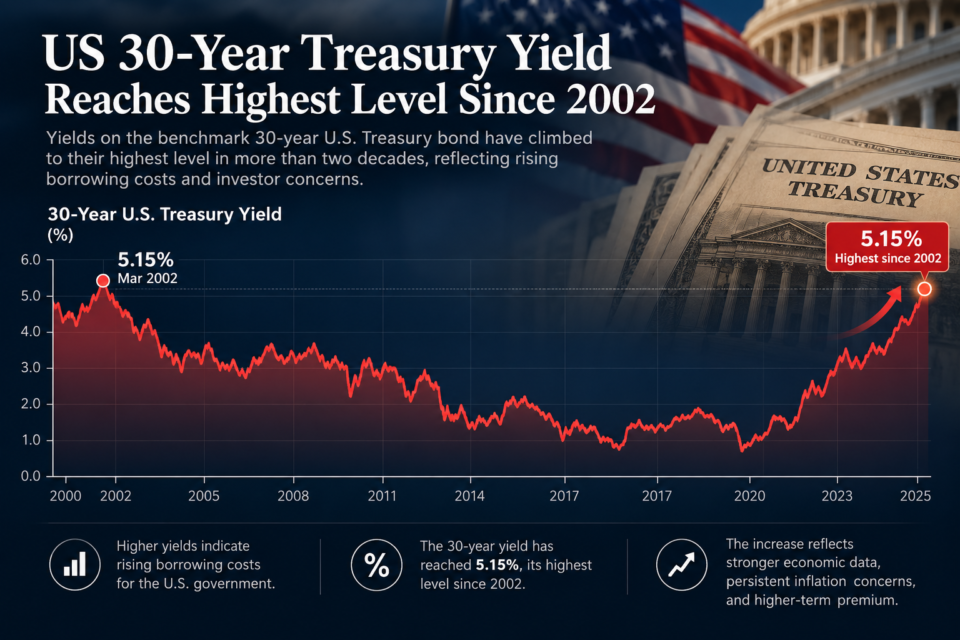
The 30-year Treasury yield rose above 5.6% on Tuesday, September 29, 2026, reaching its highest level since June 2002. Reuters put the peak at about 5.62%. The move shows how oil prices, stubborn inflation and bets on further Federal Reserve rate increases are pushing up borrowing costs across markets.
What Happened to the 30-Year Treasury Yield
Long-dated US government bonds sold off for a sixth straight session, Bloomberg reported. The benchmark 10-year yield climbed to 5.293%, its highest since June 2007.
Yields eased from their session highs later in the day. The Dow Jones Industrial Average closed about 130 points lower, and Wall Street finished modestly down. Nvidia slipped 0.7%, according to the Associated Press, while Broadcom gained 1.6%.
The retreat from the highs followed remarks by New York Fed President John Williams. He said policymakers had time to weigh incoming data before deciding when to raise rates again. Asian stock futures pointed higher on Wednesday as oil prices eased, Bloomberg reported.
Why It Matters
Long-term yields anchor mortgage rates, corporate borrowing and government financing costs. When they rise, companies pay more to borrow, and investors demand more from stocks. Utilities have been hit hard, IBTimes reported, because bonds now compete with dividend payers.
Bloomberg also pointed to heavy corporate-debt supply as a pressure on the market. Bloomberg strategist Tatiana Darie has said stocks and bonds remain vulnerable, with “peak hawkishness” still far off by historical standards.
The Labor Department’s August consumer price index rose 0.4% on the month, and core prices rose 0.3%, the largest increase since April, Reuters reported. Inflation-adjusted average hourly earnings fell 0.3% over the year, so households are losing purchasing power as borrowing costs climb.
The 30-year yield now sits at levels last common before the financial crisis. That marks a sharp break from the low-rate era that followed it.
Key Details
- 30-year yield: about 5.62%, the highest since June 2002
- 10-year yield:293%, the highest since June 2007
- Fed policy: a 25-basis-point increase earlier in September
- Rate expectations: money markets price about 100 basis points of further Fed hikes over 12 months, according to LSEG data cited by the Wall Street Journal
- October odds: CME FedWatch put the chance of a hike at 51.5% after Williams spoke, down from nearly 70% earlier in the session
- Inflation: US consumer prices rose 3.4% in August from a year earlier
Broader Context
Fed officials are not speaking with one voice. Williams sounded patient. Governor Michael Barr said more hikes are likely to be needed. Chicago Fed President Austan Goolsbee warned that letting inflation stay above target for five and a half years is risky.
Energy prices are a central driver. Danske Bank analyst Antti Ilvonen said yields remain under upward pressure because the US and Iran appear stuck in negotiations. Brent crude has traded near $100 a barrel through much of September.
Precious metals have felt the squeeze as well. Spot gold fell about 4% on Monday, its worst day since June, as yields rose, FXStreet reported. It recovered roughly 1.4% on Tuesday to about $4,172 an ounce, according to Invezz.
Fed Chair Kevin Warsh said at his September 16 press conference that the 4.1% unemployment rate in August was consistent with full employment, according to an Investing.com preview. That leaves inflation as the central policy concern.
Other central banks are tightening too. Australia has lifted its cash rate to a 15-year high, according to Bloomberg-sourced market coverage, and FXStreet noted that the Bank of Japan has also raised rates.
What Happens Next
Two data points loom. The Bureau of Economic Analysis is due to release August personal consumption expenditures (PCE) inflation on Wednesday, September 30. Economists expected the annual headline rate near 3.7%. Annual revisions to past data will arrive at the same time and may lower recent core readings, Seeking Alpha reported.
On Friday, the US September jobs report follows. One economic preview expects payrolls to rise by roughly 100,000, after August’s gain of 162,000. Micron Technology also reports results after the market close on Wednesday, which investors will read for signs of AI demand.
Any hot inflation reading would likely strengthen bets on an October Fed hike. A softer print could give long-term bonds some relief. Either way, the 30-year yield has become a key gauge of how much pressure higher rates are putting on markets.
