
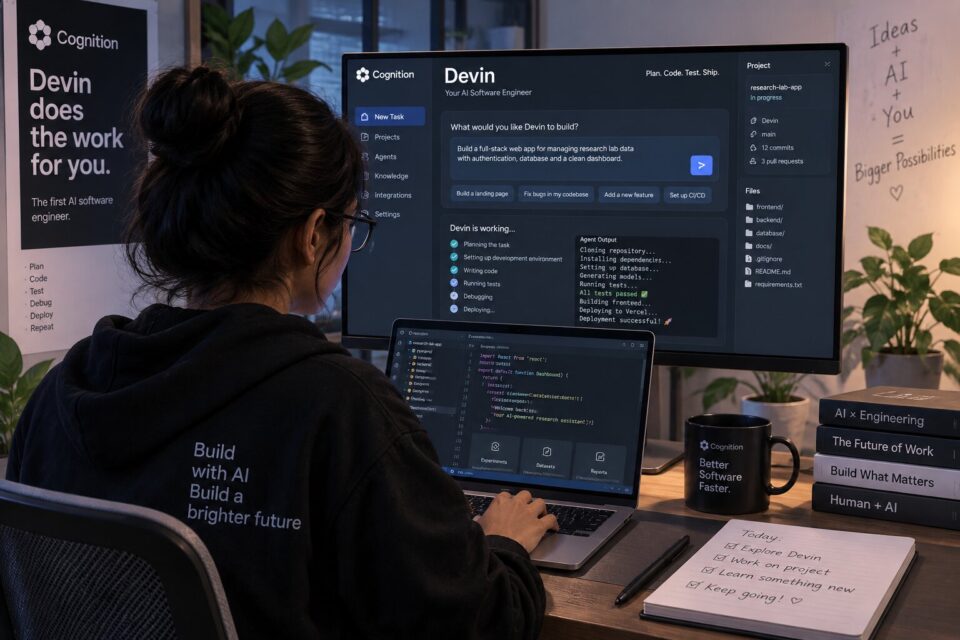
Cognition Valued at $48 Billion After $2 Billion Series E as AI Coding Race Intensifies
Cognition, the San Francisco-based artificial intelligence startup behind autonomous coding agent Devin, has raised more than $2 billion in a Series E funding round at a $48 billion valuation, nearly doubling its valuation from just four months earlier.
The September 8 funding announcement represents one of the year’s biggest private AI financing rounds and highlights the enormous investor appetite for companies developing AI agents capable of performing increasingly sophisticated software-engineering work.
The round was led by new investors Andreessen Horowitz (a16z) and Accel, alongside existing backers including Founders Fund, General Catalyst and Avenir. A long list of other investors also participated, including Benchmark, Bessemer Venture Partners, Kleiner Perkins, Greylock, Lightspeed and NVIDIA.
From $26 Billion to $48 Billion
Cognition’s latest valuation marks a dramatic increase from its previous financing in May 2026. The company raised more than $1 billion in that round at a $26 billion post-money valuation.
That means Cognition’s valuation has risen by roughly 85% in around four months.
The increase has been accompanied by rapid growth in the company’s reported revenue. Cognition said its annualized run-rate revenue increased from $492 million in May to nearly $900 million by September.
The company attributes the growth to increasing enterprise adoption of Devin, its AI software-engineering agent.
Devin Moves Beyond Traditional Coding Assistants
Unlike conventional AI coding assistants that primarily autocomplete or suggest code, Cognition positions Devin as an autonomous software engineer capable of taking on larger portions of the development process.
The platform can plan tasks, write and test code, investigate incidents, identify security vulnerabilities and automate engineering workflows.
Cognition says Devin is being used by companies across several industries, including NVIDIA for chip-design work, GE Aerospace in aviation, Citi in financial services, Mercedes-Benz in automotive and Modal in AI infrastructure.
The company’s latest product capabilities include Devin Auto-Triage, which can investigate incidents, and Devin Security Swarm, designed to identify and triage software vulnerabilities. Cognition has also introduced automation features that can initiate engineering tasks based on events in platforms such as GitHub, Slack and Linear.
AI Coding Becomes a Major Investment Battleground
Cognition’s fundraising comes as competition intensifies across the AI coding market.
Developers and enterprises are increasingly adopting AI agents from companies ranging from specialized coding startups to major AI laboratories. The emergence of products such as Anthropic’s Claude Code and OpenAI’s coding tools has raised questions over whether independent companies such as Cognition can maintain a strong position as foundation-model providers move deeper into software development.
Cognition is attempting to differentiate itself by operating as an independent agent company rather than relying exclusively on a single AI model provider. The company says it can combine different models depending on the task.
That strategy could become increasingly important as the cost of running sophisticated AI agents remains high.
Rapid Growth Comes With Heavy AI Infrastructure Costs
Cognition’s revenue growth has been impressive, but building autonomous AI software engineers requires substantial computing resources.
TechCrunch reported that Cognition leases a large NVIDIA server cluster costing hundreds of millions of dollars annually, while The Information has reported that the company’s cash burn could reach approximately $800 million this year.
That makes the economics of AI coding an important question for investors.
A nearly $48 billion valuation implies that investors expect Cognition’s revenue and margins to continue expanding rapidly as enterprises increase their use of AI agents.
Windsurf Acquisition Strengthened Cognition’s Position
Cognition has also expanded through acquisitions. In 2025, the company acquired Windsurf, an AI coding company, following a complicated series of events surrounding a proposed deal involving another major AI company.
The acquisition gave Cognition additional technology, products and engineering talent in the increasingly competitive AI coding market.
What the $48 Billion Valuation Means
Cognition’s latest funding round illustrates how investors are increasingly valuing AI companies based not only on current revenue but also on their potential to automate entire categories of knowledge work.
Cognition says its broader vision is to allow human engineers to focus increasingly on architecture, planning and higher-level decision-making while AI agents handle more of the execution.
That vision is also reflected in a statement from a16z following its investment. The venture firm said Devin had gone from writing 13% of Cognition’s production code a year earlier to more than 90%, highlighting the company’s own aggressive adoption of its technology.
The challenge now is turning that technological progress into sustainable economics.
Cognition has demonstrated that investors are willing to place enormous bets on autonomous software engineering. Its next test will be whether Devin’s growing enterprise adoption can justify a $48 billion valuation while the company manages the enormous computing costs and increasingly intense competition surrounding AI coding.
For now, the message from investors is clear: AI agents are no longer being treated simply as coding assistants—they are increasingly being positioned as a new layer of the software-engineering workforce.
