
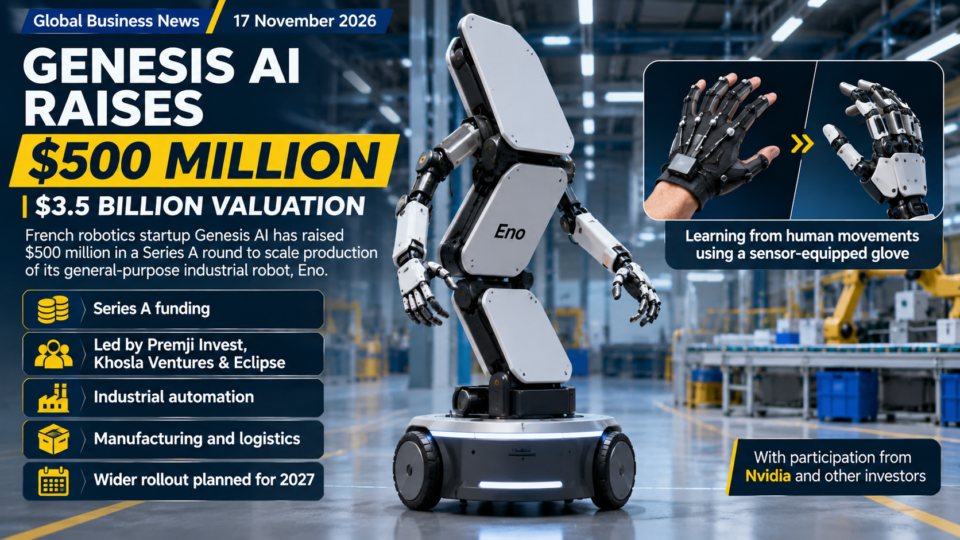
French robotics startup Genesis AI has raised $500 million in a Series A funding round, reaching a valuation of $3.5 billion and highlighting growing investor interest in artificial intelligence-powered industrial robots.
The funding announcement was made on November 17. The company plans to use the capital to increase production of its general-purpose robot, expand AI training and improve the machine’s ability to perform complex physical tasks.
The investment represents one of the major funding rounds in Europe’s emerging robotics industry.
Who Invested in Genesis AI?
The funding round was co-led by Khosla Ventures, Premji Invest and Eclipse.
Other investors included former Google chief executive Eric Schmidt, French technology entrepreneur Xavier Niel, Nvidia and French state-backed investment institution Bpifrance.
The participation of major technology investors reflects growing interest in companies developing AI systems that can operate in physical environments.
Rather than focusing only on software applications, Genesis AI is developing the hardware, AI models and training systems required to make robots useful in industrial settings.
What Is the Eno Robot?
Genesis AI’s flagship product is called Eno.
It is a general-purpose robot designed for industrial applications such as manufacturing and logistics.
Unlike traditional humanoid robots, Eno does not follow a conventional human body structure.
Its design uses three folding body segments mounted on a rotating wheeled base. The robot can fold into a compact shape and extend to approximately human height when performing tasks.
The company has placed particular emphasis on developing dexterous hands.
This is an important technical challenge because robots must be able to grip, move and manipulate objects with accuracy to perform useful industrial work.
A robot that can simply move around a factory is not necessarily capable of completing complicated manufacturing tasks. Reliable object manipulation is therefore a major area of development.
Where Will the Funding Be Used?
Chief executive Zhou Xian said the funding would support several priorities.
These include increasing Eno production, expanding data collection, improving AI training and developing better hand manipulation capabilities.
Genesis is building its AI software, hardware and training systems together.
The company also designs components such as actuators, motors, gearboxes and robotic hands.
It uses Nvidia computing chips as part of its development infrastructure.
This integrated approach is intended to improve the speed at which the company can test and refine its robots.
Early Customer Testing
Genesis AI is already testing a limited number of robots with customers.
One important partnership involves South Korean company LG CNS, through which Eno is being tested for manufacturing and logistics applications.
The company is initially prioritising the United States, where it plans to develop a supply chain and work with contract manufacturers and customers.
It expects broader customer rollout in 2027.
Why Investors Are Interested in Industrial Robotics
Factories and logistics companies are increasingly exploring automation to improve productivity, reduce repetitive manual work and manage labour shortages.
Traditional industrial robots are usually designed for specific tasks and operate within carefully controlled environments.
General-purpose robotics aims to create machines that can handle a wider range of activities.
Artificial intelligence could make these systems more adaptable by allowing them to learn from data and respond to changing environments.
However, important challenges remain, including safety, reliability, operating costs and the ability to perform tasks consistently.
What Happens Next?
Genesis AI plans to use the new capital to improve Eno and prepare for wider commercial deployment in 2027.
Its progress will be measured by how effectively the robot performs in real industrial environments, rather than by funding or valuation alone.
The latest investment demonstrates that venture capital is increasingly flowing into AI companies that combine software with physical machines.
If Genesis can successfully commercialise its technology, it could become an important competitor in the emerging market for AI-powered industrial robotics.
