
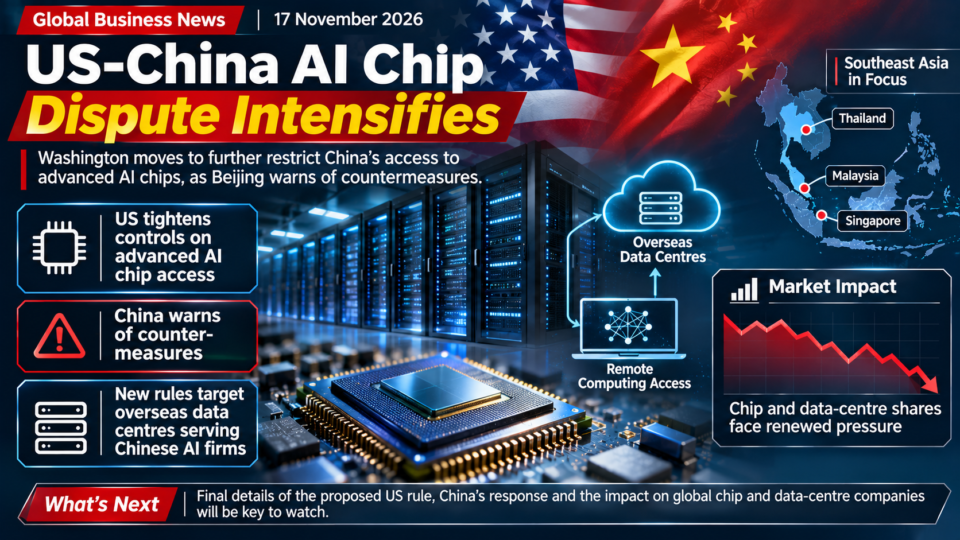
The global semiconductor industry is facing renewed uncertainty as the United States moves to further restrict China’s access to advanced artificial intelligence chips, prompting Beijing to warn that it could introduce countermeasures.
The latest development comes during a difficult period for technology stocks, with investors already concerned about high valuations, the cost of AI infrastructure and whether the industry’s rapid investment growth can deliver sustainable returns.
China’s Commerce Ministry said on November 17 that it firmly opposed the proposed US restrictions and would take countermeasures if Washington continued with the new rule.
What Is the United States Planning?
The latest US move aims to further restrict China’s access to advanced AI chips, including products from major semiconductor companies such as Nvidia.
Advanced processors are essential for training and operating large AI models.
They are also used in data centres, scientific computing and other high-performance applications.
The United States has previously introduced export controls covering advanced chips and related technologies.
The latest proposed restrictions represent another step in Washington’s efforts to limit China’s access to strategically important computing capabilities.
China Warns of Countermeasures
China’s Commerce Ministry said it opposed the new US rule and called for differences to be resolved through consultation and cooperation.
It also warned that Beijing would respond if Washington proceeded with the restrictions.
The statement adds another layer of uncertainty to the technology relationship between the world’s two largest economies.
Potential countermeasures could affect trade relationships and companies operating across the semiconductor supply chain.
However, China has not specified the exact measures it might introduce in response to the proposed restrictions.
Why Semiconductor Stocks Are Under Pressure
The geopolitical dispute is developing alongside a wider correction in technology shares.
According to Reuters, the Philadelphia Semiconductor Index has fallen 34% since late June, although it remains more than 35% higher for 2026.
Nvidia, Intel and Micron have experienced significant share-price declines since the Nasdaq’s October peak.
Investors are increasingly questioning whether the enormous investments being made in AI infrastructure will generate sufficient financial returns.
The industry also faces uncertainty over the effect of regulations on data-centre expansion and access to computing equipment.
Nvidia Earnings in Focus
Nvidia’s quarterly results are a major event for investors watching the semiconductor industry.
The company is one of the most important suppliers of processors used in AI infrastructure.
Its financial performance is often viewed as an indicator of demand for advanced computing hardware.
Investors are watching revenue, future guidance and commentary on AI spending.
They are also monitoring the implications of changes in company leadership and the broader regulatory environment.
The options market has indicated that Nvidia’s results could trigger a substantial change in the company’s market value.
Impact on the Global Technology Industry
Semiconductor production depends on a highly interconnected international supply chain.
Companies in the United States, Taiwan, South Korea, Japan, Europe and other regions contribute to chip design, manufacturing equipment, materials and packaging.
Export restrictions can therefore affect companies beyond the country directly targeted by the policy.
Businesses may need to adjust their supply chains, reassess customer exposure and consider where advanced products can legally be sold.
The uncertainty could also influence investment decisions involving data centres and AI infrastructure.
What Happens Next?
The immediate developments to watch include the final implementation of the proposed US restrictions, China’s response and Nvidia’s financial outlook.
The semiconductor industry remains strategically important to the global economy, but investors are becoming more selective.
The latest dispute illustrates how technology policy and international trade are increasingly connected.
For semiconductor companies, future growth will depend not only on demand for AI computing but also on regulatory access to international markets and the ability to manage geopolitical risks.
