
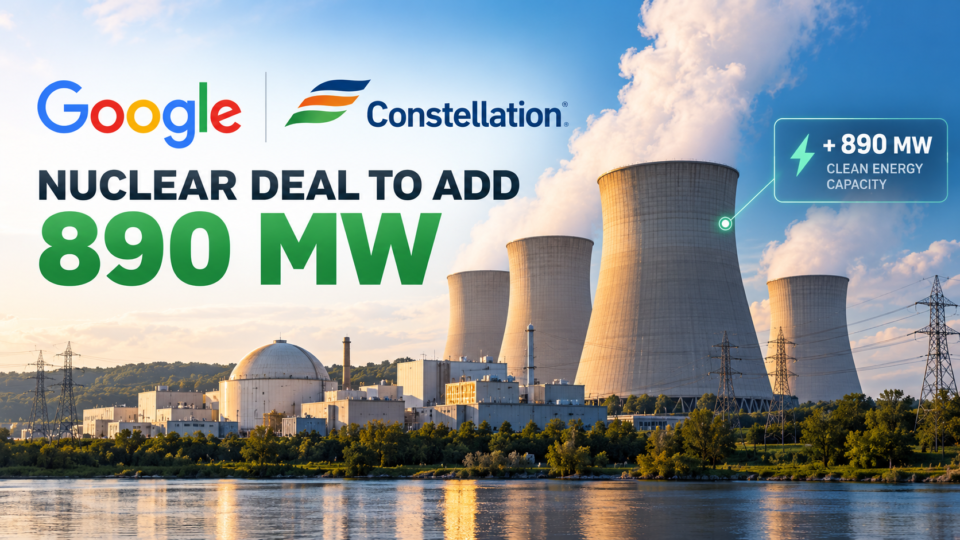
Google and Constellation Energy have signed a 20-year agreement to add 890 megawatts of nuclear capacity to the largest power grid in the United States. The Google Constellation nuclear deal, announced on Tuesday, October 6, 2026, will fund upgrades at 11 existing nuclear units. Constellation will invest more than $4.3 billion, and its shares jumped in premarket trading.
The companies also signed a separate 15-year supply agreement for another 2,700 megawatts. Together, Google has contracted for 3,590 megawatts of power in the PJM Interconnection, Reuters reported.
What the Google Constellation Nuclear Deal Includes
The 20-year power purchase agreement covers 890 megawatts of new nuclear output. The extra power will come from investments in new equipment and technology at 11 Constellation-owned units in Illinois, Pennsylvania and New Jersey.
These upgrades, known as uprates, increase thermal and electrical efficiency. They allow existing reactors to produce more electricity without building new ones. The first additional capacity is expected by 2028.
The second agreement runs for 15 years. It covers 2,700 megawatts from Constellation’s existing fleet in PJM, which supplies power to 67 million people across 13 states in the Mid-Atlantic and Midwest.
The deal also includes a framework to explore future clean generation, storage and demand-response projects across the country, starting in PJM. It builds in demand flexibility, meaning that non-critical power use can be reduced during high-stress grid events.
Why It Matters
Data centers are driving up electricity demand, and large technology companies are looking for firm, carbon-free power. Nuclear plants run around the clock, which suits that need.
This agreement differs from earlier deals. Instead of building new reactors or restarting closed plants, it pays for more output from reactors already operating. Constellation said it will commit more than $4.3 billion to fund the build-out.
The structure is also a response to a policy proposal. PJM management has proposed that data center customers must either bring their own power or face remote shutoffs during peak demand. The companies say the deal fits that “Bring Your Own Power” framework. They say it lets a major power user add supply without state or federal mandates and without passing costs to residential customers.
Key Details
- Agreement 1: 20-year power purchase agreement for 890 MW of new nuclear capacity.
- Agreement 2: 15-year supply agreement for 2,700 MW from Constellation’s existing PJM fleet.
- Plants: 11 nuclear units in Illinois, Pennsylvania and New Jersey.
- Investment: More than $4.3 billion committed by Constellation.
- Timing: First uprate expected by 2028.
- Market reaction: Constellation shares rose about 9% in premarket trading, according to TheStreet.
Broader Context
Technology companies have signed a growing number of nuclear-related deals. Over the past two years, Constellation announced an agreement to restart its Three Mile Island reactor in Pennsylvania to serve Microsoft data centers. Google also contracted for the restart of a nuclear plant in Iowa owned by NextEra Energy, Reuters noted.
Constellation is the largest nuclear plant operator in the United States and also owns a large fleet of natural-gas power plants. The company struck a similar 20-year arrangement with Amazon last week, according to Quartz and Bloomberg reporting.
Taken together, these deals show how the demand for computing power is reshaping the electricity market. Utilities and generators are signing long contracts with technology firms to secure funding for new supply.
What Happens Next
The next milestones involve engineering and approvals. Constellation must carry out the upgrades at the 11 units, and the first additional capacity is expected by 2028. The timing of later uprates was not detailed in the announcement.
The agreement also depends on how PJM finalizes its “Bring Your Own Power” proposal. If adopted, the proposal could shape how other large electricity users secure supply.
Observers will also watch whether other grid operators and technology companies copy this model. For now, the deal gives Google long-term access to nuclear power in a grid region that is under growing demand pressure, and it gives Constellation funding to expand output at existing plants.
