
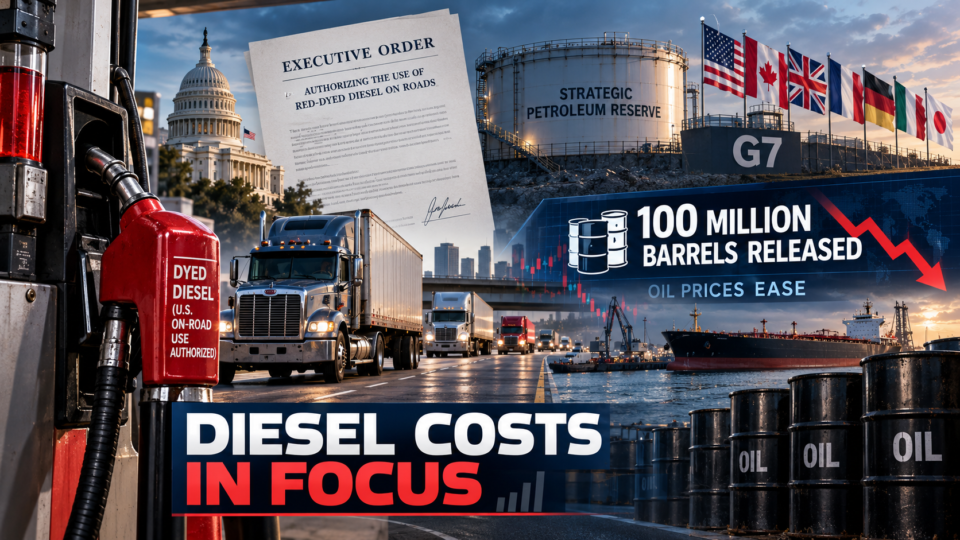
President Donald Trump has signed an executive order allowing cheaper red-dyed diesel to be used more widely, in a fresh attempt to bring down record fuel costs. The order, signed Monday evening and reported on October 6, 2026, comes as diesel prices in the United States have climbed to unprecedented levels. Oil prices fell on Tuesday after a coordinated release of emergency reserves by the Group of Seven (G7).
CNBC reported the order, and TheStreet summarized the details.
What Happened to Diesel Prices and the New Order
Red-dyed diesel is usually reserved for farm equipment, construction machinery and other off-road uses. It is exempt from the 24.4-cent-per-gallon tax that applies to diesel sold for highway use. Using it on public roads is normally illegal and can bring fines for tax evasion.
The new order temporarily allows truckers and farmers to use red-dyed diesel more broadly. It also defers related taxes through the end of the year. Several states have already relaxed their own restrictions on tax-exempt diesel this year to help drivers cope with rising costs.
The U.S. national average diesel price topped 700 million more per day on gasoline and diesel than they did a year ago.
Why Diesel Prices Matter to the Economy
Diesel powers trucks, farm machinery, trains and ships. When it becomes more expensive, the effect usually spreads through freight and food costs. Trucking companies and owner-operators, who rely on fuel as one of their largest expenses, are especially exposed.
That makes diesel a political and economic pressure point as well as an energy issue. The order is a short-term measure, and it targets costs for businesses that move goods and grow food.
Oil Prices Ease on G7 Reserves
Crude prices softened on Tuesday. West Texas Intermediate fell 1.86% to 98.67 in early trading, as reported by TheStreet.
The decline followed the G7 decision announced on Friday, October 2. The group agreed to release up to 100 million barrels of oil and fuel from emergency reserves over four months. A substantial diesel release is front-loaded into the first 20 days. The allocation among members will be worked out through the International Energy Agency (IEA).
The move followed a week of pressure from the Trump administration on European allies. Trump had threatened to stop all U.S. diesel exports unless Europe released its own stocks, NPR reported. The United States separately approved another 40 million barrels from its Strategic Petroleum Reserve, completing its share of an earlier IEA pledge of 400 million barrels made in March.
Shipping data cited by Reuters shows that Gulf oil exporters surpassed pre-war levels for roughly half of September.
Key Details
- Executive order: Signed Monday evening; allows broader use of red-dyed diesel and defers related taxes through year-end.
- Diesel price: National average above $6 a gallon in September, a first.
- G7 release: Up to 100 million barrels over four months, with a front-loaded diesel release in the first 20 days.
- Oil benchmarks: WTI at 67 in early Tuesday trading.
- Extra spending: About $700 million more per day on gasoline and diesel than a year ago, per Rapidan Energy.
Broader Context
Supply risks have not gone away. Iran has stepped up attacks on tankers moving through the Strait of Hormuz, CNBC reported. Nearly 20 commercial ships, mostly tankers, have been attacked over the past month in the strait, the Persian Gulf or off Oman, according to the Joint Maritime Information Center.
Maritime intelligence firm Windward estimates that Iran attacked about two ships for every 100 vessels that crossed the strait in the third quarter. Oil flows through Hormuz now depend on a U.S. military commitment to protect tankers using a southern route near the coast of Oman.
Other pressures add to the squeeze. Analysts note that Ukrainian drone strikes have reduced Russian refining capacity, and Russian diesel exports have been banned. That has tightened global diesel supplies further.
What Happens Next
The G7 has said that the IEA will discuss whether further diesel releases are needed. Details of how the 100 million barrels will be shared among members remain to be settled.
The executive order’s tax deferral runs through the end of the year. Whether it lowers costs for truckers and farmers will depend on how quickly fuel moves through the supply chain.
It is also unclear how long the recovery in Gulf crude exports can continue without a negotiated settlement that provides greater security for shipping. Until then, oil and diesel prices are likely to stay sensitive to any new attack or supply disruption.
