
OpenAI Annualized Revenue Falls Below Earlier Estimates, Triggering Tech Stock Selloff
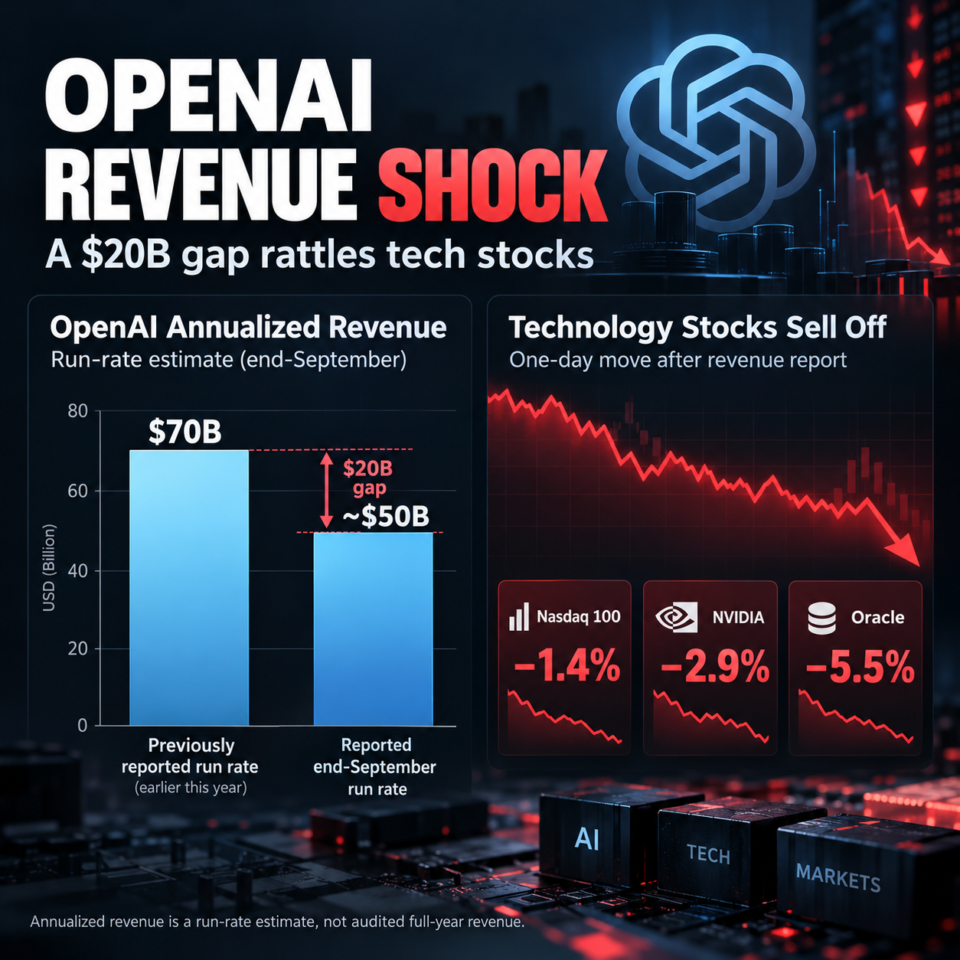
OpenAI told investors its annualized revenue reached roughly $50 billion, below figures that had circulated widely. CNBC confirmed the number after the Financial Times first reported it on Thursday, October 8. The news hit technology stocks that day. Shares of Nvidia, Oracle and CoreWeave fell, and the Nasdaq Composite dropped more than 1%.
What Happened to OpenAI Annualized Revenue
The Financial Times reported that OpenAI’s annualized revenue was approaching $70 billion. CNBC said a $68 billion number had been widely reported late last month.
The gap appears to come from accounting. Axios reported that the higher figure was built from investor attempts to compare OpenAI directly with rival Anthropic. Anthropic counts sales made through its cloud partners in its tally. OpenAI records only its share of certain partner sales. Both companies follow standard accounting rules, according to Axios, but they treat the revenue differently. Under Anthropic’s approach, the cloud provider’s cut is listed as an expense rather than deducted from revenue.
Annualized revenue is a snapshot, not an audited result. It takes a recent period’s sales and projects them across twelve months. Startups use it widely, though public-market investors usually prefer reported revenue.
Why It Matters
The number matters because of how much money is riding on AI growth. TechCrunch noted that OpenAI raised $122 billion in a single round in March. The company has also committed to heavy spending on computing infrastructure. Investors want proof that revenue can grow fast enough to support those plans.
At $65 billion, according to Yahoo Finance. The comparison depends heavily on the accounting methods, so analysts caution against reading it as a pure measure of demand.
OpenAI also shared growth figures. A person familiar with the matter told CNBC the company reported 77% growth in total run rate during the third quarter. Enterprise run-rate growth was 107% over the same period.
Key Details
-
Report: Financial Times, Thursday, October 8, 2026; confirmed by CNBC
-
Figure: Roughly $50 billion annualized revenue at end of September
-
Earlier figures: About $70 billion in prior reports
-
Cause of gap: Different treatment of cloud-partner sales, per Axios
-
Growth cited: 77% total run-rate growth and 107% enterprise growth in the third quarter
-
Year-end target: Bloomberg reported OpenAI aims to reach $70 billion annualized by the end of 2026
The market reaction was concentrated in chips and AI infrastructure. The Philadelphia Semiconductor Index fell 3.4% on Thursday. Broadcom dropped 4.35%, Micron 4.79%, AMD 3.9% and Nvidia 2.94%, according to a Wall Street market wrap. The Nasdaq closed down about 1.25% that day.
Broader Context: A Market Sensitive to AI Numbers
Thursday’s drop showed how sensitive markets have become to AI data points. Adam Crisafulli of Vital Knowledge said the selloff reflected crowded positioning that still had room to unwind. He also pointed to signs that investors are pushing back on the volume of AI-linked debt and equity coming to market.
Other analysts reached a different view. Some described the selloff as overdone, saying the revenue difference reflects accounting rather than weaker demand. That reading is supported by the Axios explanation of the methodology gap.
The rebound came quickly. In premarket trading on Friday, CoreWeave rose about 2.5%, while Oracle and Broadcom each gained about 1.5%. By the close on October 9, the Nasdaq had gained 0.64% to finish at 27,366.17. Even so, the episode left investors more alert to how AI companies define and report their sales.
What Happens Next
The next test comes from OpenAI’s own communications. The company has not published audited figures, so investors will rely on further disclosures and leaks. Bloomberg’s report on a $70 billion year-end target will be a benchmark for any updates.
Earnings season also begins next week for many U.S. companies. Results from firms that supply computing power to AI developers may show whether spending plans have changed. Analysts will watch cloud and chip companies for comments on demand.
The accounting debate may continue as well. If OpenAI and Anthropic keep reporting revenue under different methods, comparisons between them will stay contested.
