
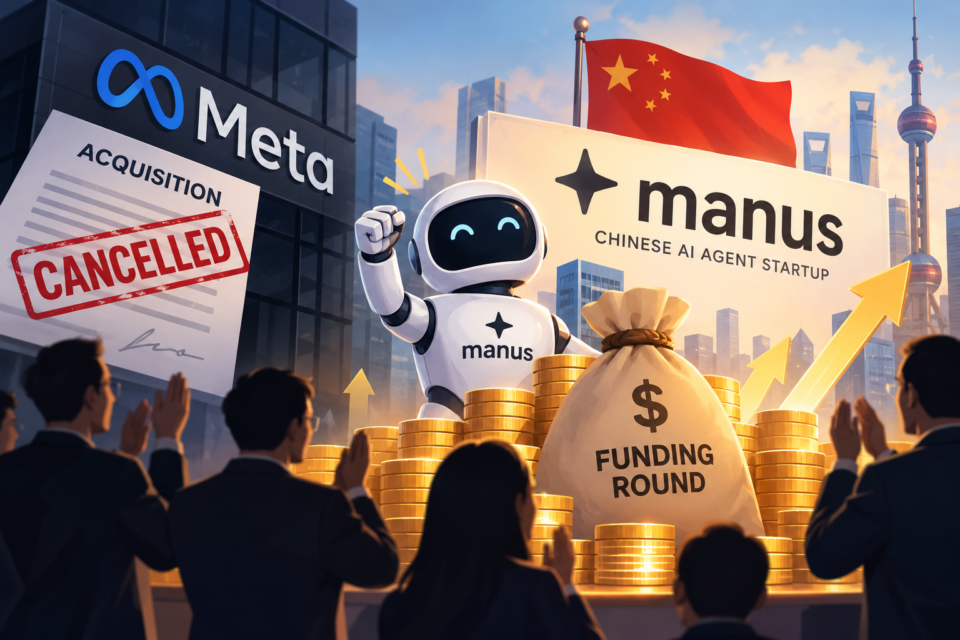
Manus Raises Over $500 Million: What It Signals for the AI Industry
Chinese AI startup Manus has raised more than $500 million in a new funding round, according to an announcement by its parent company, Butterfly Effect, on October 8, 2026.
The round was led by Boyu Capital and IDG Capital, with existing investors Tencent, HSG (formerly Sequoia China), and ZhenFund also participating.
The company has not disclosed its valuation.
What Happened?
Manus develops AI agents — software systems designed to complete multi-step tasks with limited human guidance.
The startup gained widespread attention after a demonstration of its AI agent went viral in 2025.
Bloomberg previously reported that Manus was targeting a $4 billion valuation in this funding round. However, that figure remains unconfirmed.
Why Does This Matter?
The funding comes after Manus’s proposed acquisition by Meta was blocked by Chinese authorities.
Meta announced its approximately $2 billion acquisition deal in December 2025. In April 2026, Chinese authorities ordered the transaction to be unwound, and Manus subsequently resumed independent operations.
Despite this setback, the latest funding suggests that investors continue to see potential in the company.
Key Details
- Funding raised: More than $500 million
- Announcement date: October 8, 2026
- Lead investors: Boyu Capital and IDG Capital
- Other participating investors: Tencent, HSG, ZhenFund and others
- Reported target valuation: $4 billion, not officially confirmed
- Parent company: Butterfly Effect
The Bigger Picture: AI Agents and Business
Unlike conventional AI chatbots that primarily answer questions, AI agents aim to execute tasks across multiple steps.
These capabilities could help businesses automate research, administrative work, data analysis, and other repetitive processes.
Manus’s funding also highlights the growing competition to attract AI talent and build commercially viable AI applications.
What Happens Next?
Manus plans to continue hiring in China and internationally. However, it has not yet provided detailed plans for deploying the new capital or confirmed its valuation.
Important questions remain about its future product strategy, international expansion, and ability to generate sustainable revenue as an independent company.
The bigger question: As AI agents become more capable, will the next major AI companies be built around models that answer questions or agents that actually get work done?
