
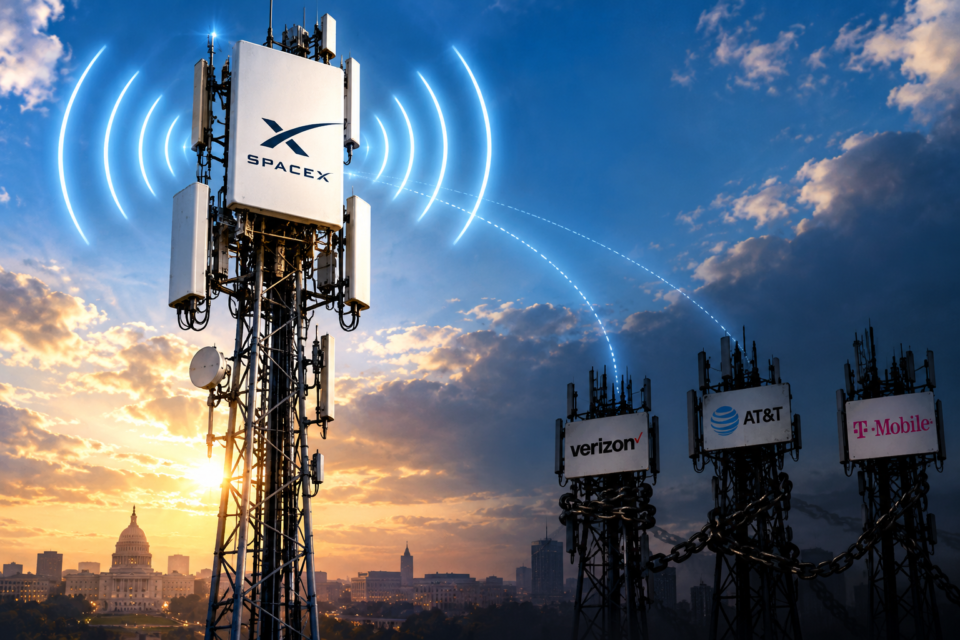
SpaceX has agreed to buy a nationwide portfolio of 800 MHz wireless spectrum licenses from private equity firm Grain Management. The SpaceX spectrum deal, announced Thursday, October 8, sent shares of Verizon, AT&T and T-Mobile sharply lower. The company says the airwaves will help its Starlink Mobile service become a major U.S. carrier. The agreement still needs approval from the Federal Communications Commission.
What Happened in the SpaceX Spectrum Deal
SpaceX said the portfolio covers up to 14 megahertz of paired spectrum in the 800 MHz band. It is buying all of Grain’s holdings in that band. Reuters reported that the terms were not disclosed. Some media reports, citing the Wall Street Journal, have put the value near $8 billion, but SpaceX has not confirmed a price.
Elon Musk called the purchase a “very big deal” in a post on X. SpaceX described the licenses as filling one of the remaining technical gaps for Starlink Mobile.
The market reaction was swift. The three biggest U.S. carriers fell in after-hours trading on Thursday. The selling continued Friday. In morning trading, according to the Associated Press, T-Mobile dropped 9.7%, AT&T fell 6.85% and Verizon lost 5.4%. Later reports put the declines closer to 10% for some of the stocks. CNBC said Verizon was on pace for its steepest one-day fall since 2002.
Tower owners moved the other way. Crown Castle jumped 10.2% and American Tower gained 7% in the same morning session.
Why It Matters
The deal turns a long-running concern for carriers into a concrete step. Investors have worried for months that Starlink could move from partner to rival.
Low-band spectrum matters because of physics. Signals in the 800 MHz range travel farther than higher-frequency bands. They also pass through building materials with less loss, according to Forbes. That helps with indoor coverage, which satellites struggle to provide on their own.
SpaceX had already bought wireless licenses from EchoStar in two deals worth about $19.6 billion in total, according to Reuters reporting. On an earnings call in August, SpaceX president Gwynne Shotwell said the company intends to build out terrestrial infrastructure. She said Starlink would win “quite a few” customers from the big three carriers.
Key Details
- Seller: Grain Management, a private equity firm focused on digital infrastructure
- Spectrum: Nationwide 800 MHz portfolio, up to 14 MHz of paired spectrum
- Buyer: SpaceX, for its Starlink Mobile service
- Price: Not disclosed by SpaceX; media reports cite about $8 billion
- Approval needed: Federal Communications Commission
- Market reaction: Verizon, AT&T and T-Mobile fell sharply; Crown Castle and American Tower rose
The chain of ownership adds an unusual twist. Grain acquired the same portfolio from T-Mobile in August, in an exchange involving cash and Grain’s 600 MHz licenses. The assets therefore changed hands twice in about two months.
Broader Context: Carriers Push Back
The carriers have not stood still. Last week, AT&T, Verizon and T-Mobile formed a joint venture to expand satellite coverage in underserved areas. Starlink was left out. T-Mobile has also dropped Starlink from its T-Satellite promotions.
Executives at all three carriers have said recently that they do not expect satellite-based mobile service to compete with their terrestrial networks. Analysts have offered a mixed view of the threat. Reuters reported in August that building a national carrier would take years of investment. Some analysts said it would be very hard without a network access agreement with a major operator.
Industry expert Tim Farrar noted that the amount of spectrum in this deal is limited. The scale of the market is large. Shotwell said on the August call that the three carriers together earn roughly $600 billion a year.
Regulators are also active. This week, the FCC said it would vote on auctioning 25 megahertz of prime spectrum for satellite-to-phone services.
What Happens Next
The first step is regulatory. The Grain transfer needs FCC approval and must satisfy other closing conditions.
SpaceX has not said when Starlink Mobile service using the new spectrum will reach customers. Reuters reported in August that the company plans to launch next-generation Starlink Mobile satellites in 2027. It is targeting upgraded service by the end of that year.
The FCC vote on satellite-to-phone spectrum is another milestone to watch. So is any response from the carriers, including further partnerships or spectrum purchases. Investors will also look for confirmation of the price once filings or company statements provide it.
