
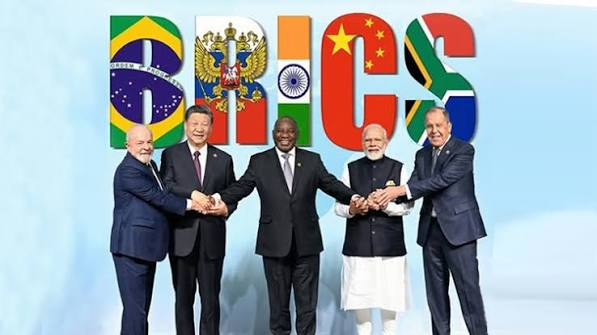
BRICS Nations Unite Behind New Delhi Declaration, Push Back on Tariffs and Trade Barriers
Leaders of the eleven-member BRICS bloc unanimously adopted the New Delhi Declaration on Saturday at the conclusion of the eighteenth BRICS Summit, issuing a joint statement that voiced serious concerns over the rise of unilateral tariffs and trade-distorting measures while calling for a more equitable and multipolar approach to global economic governance.
Indian Prime Minister Narendra Modi announced the declaration’s adoption at the summit in New Delhi, noting that no member state had raised objections to the final text. The gathering, held under India’s 2026 chairship theme of “Building for Resilience, Innovation, Cooperation and Sustainability,” brought together leaders including Chinese President Xi Jinping, Russian President Vladimir Putin, and Iranian President Masoud Pezeshkian, among the heads of state representing Brazil, India, China, Russia, South Africa, Egypt, Ethiopia, Indonesia, Iran and the United Arab Emirates.
Trade Tensions Take Center Stage
A central theme running through the declaration was the bloc’s collective unease over the growing use of unilateral tariffs and non-tariff barriers that member states argue distort international trade and run counter to World Trade Organization rules. The statement reflects mounting frustration among emerging economies over trade policy shifts in major Western markets that have complicated export strategies for BRICS members over the past year.
Diplomats involved in drafting the declaration reportedly worked through significant behind-the-scenes friction to reach consensus, particularly reconciling differing positions between Iran and the United Arab Emirates over escalating tensions in West Asia. The final compromise text avoided naming specific countries while still explicitly addressing concerns over unilateral military and economic actions, a balancing act diplomats said was necessary to preserve unity across a bloc whose members hold sharply differing geopolitical alignments.
A Bloc Representing a Growing Share of the Global Economy
BRICS, originally established in 2009 as a forum for major emerging economies seeking greater influence within global institutions historically dominated by Western powers, has expanded significantly in recent years and now accounts for more than 40 percent of the world’s population and close to a quarter of global economic output. The New Delhi summit marked the fourth time India has held the bloc’s rotating chairship, following previous stints in 2012, 2016 and 2021.
The declaration reaffirmed the bloc’s commitment to what it described as a more just and equitable framework for global governance suited to what leaders characterized as the realities of an increasingly multipolar world. It also renewed calls for reform of international institutions, including a pointed reference to the ongoing selection process for the next United Nations Secretary-General, noting that no woman has ever held the position and that only a limited number of nationals from Latin America, Africa and Asia have ever occupied the role.
Middle East Tensions and Calls for Restraint
Beyond economic matters, the declaration expressed deep concern over the escalating conflict in the Middle East and West Asia, urging maximum restraint from all parties involved and calling for the protection of civilian populations and critical infrastructure, including nuclear facilities. The statement specifically emphasized that nuclear safeguards and security must be upheld even amid active armed conflict, reflecting anxiety among BRICS members about the potential for the ongoing regional conflict to escalate further and disrupt global energy markets, on which several member economies remain heavily dependent.
Prime Minister Modi, addressing the summit, called on the Global South to move beyond being a passive participant in global affairs and instead become an active shaper of international rules and norms. He noted the symbolic significance of adopting the declaration on the United Nations Day for South-South Cooperation, framing the timing as a deliberate signal of BRICS’ ambitions to lead on issues affecting developing economies.
Economic Implications Going Forward
For businesses and investors tracking emerging markets, the declaration’s emphasis on resisting unilateral tariffs signals that BRICS members are likely to continue pursuing deeper intra-bloc trade arrangements and alternative payment mechanisms as a hedge against trade policy volatility originating from outside the group. The summit also featured more than 400 associated meetings and engagements across thirty Indian cities throughout the year, spanning ministerial dialogues, business forums and technical working groups, underscoring the scale of coordination India undertook during its chairship term.
With the declaration now formally adopted, attention turns to how individual member states translate its broad principles into concrete trade and investment policy over the coming year, particularly as several BRICS economies continue to navigate their own bilateral trade negotiations with major Western partners amid a global environment increasingly shaped by tariff disputes and shifting supply chains.
