
A Historic Overture in Strasbourg
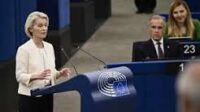
In a moment that instantly reshaped the conversation around transatlantic alliances, European Commission President Ursula von der Leyen stood before the European Parliament in Strasbourg on Wednesday and extended an invitation with no precedent in the bloc’s history: she asked Canada to become the European Union’s first-ever “associate member.”
Speaking during her closely watched annual State of the Union address, von der Leyen turned toward Canadian Prime Minister Mark Carney, who occupied a front-row seat as the first foreign head of government ever to attend the speech in person. “I would like to work with you on opening the door for Canada to be the first associate member of the EU,” she told him, prompting several lawmakers in the chamber to rise from their seats in applause. Carney left his seat, walked to the podium, and shook her hand as the room absorbed the significance of the moment.
Why Now
The timing is no accident. For much of the past year, Canada has found itself squeezed by an increasingly combative relationship with the United States under President Donald Trump, whose administration has imposed sweeping tariffs on Canadian goods while repeatedly floating the idea of absorbing Canada as the “51st state.” With roughly seven in ten Canadian exports historically bound for American markets, that pressure has left Ottawa searching for ways to diversify its economic relationships and reduce its dependence on its southern neighbor.
Carney has been unusually direct about this shift. Earlier in the week, he said Canada was pursuing a “unique alliance” with the European Union, though he stopped short of calling it a bid for membership. At the World Economic Forum in Davos earlier this year, he had also argued that so-called middle powers needed to band together to build a more cooperative, less volatile global order — a message that appears to have resonated in Brussels.
Von der Leyen framed the overture in similarly strategic terms, describing a world in “openly hostile” flux. “Partnerships are a strategic choice for Europe,” she said, pointing to fractures in the international rules-based system, an ongoing war on the European continent, and what she called a “battle of narratives” aimed at weakening confidence in Europe. She argued that Canada and the EU “see the world with the same eyes” on issues ranging from artificial intelligence to climate change to broader geopolitical competition.
From Trade Pact to Alliance
The European Union and Canada already maintain deep commercial ties through the Comprehensive Economic and Trade Agreement, known as CETA, which eliminated tariffs on nearly all trade between the two when it provisionally took effect in 2017. Von der Leyen signaled that the associate membership proposal would go well beyond that existing framework. “We will move from CETA to an alliance for the future, to create a common prosperity and economic security space,” she said, adding that cooperation would expand into manufacturing, technology, critical raw materials, energy and defense.
Notably, the “associate member” category does not currently exist under EU treaties, meaning any formal arrangement would require new legal groundwork before it could take effect. Euronews reported that details of the status remain to be worked out, and Canadian officials were quick to temper expectations. Jonathan Wilkinson, Canada’s ambassador-designate to the EU, told reporters in a brief exchange after the speech that the two sides remain “far” from finalizing what such a relationship would actually look like.
A Message With Multiple Audiences
Observers noted that von der Leyen took care to frame the proposal as inclusive rather than confrontational. “This is a partnership not against anyone else,” she said, a line widely read as an attempt to avoid further antagonizing the Trump administration even as the announcement itself carried an unmistakable political charge. She also invoked shared democratic values directly to Carney: “Above all, dear Mark, Europe and Canada believe in democracy. We believe that power does not belong to the strongest, the richest or the loudest, but to all of us.”
The idea of expanding the EU’s membership categories is not entirely new. Earlier this year, Finnish President Alexander Stubb suggested the bloc should “think big,” floating a vision of a 40-member union that could eventually include Canada, the United Kingdom, Turkey, Norway and Iceland. German Chancellor Friedrich Merz has also previously pushed for flexible membership arrangements for other partners, proposals the EU had until now been reluctant to entertain.
What Comes Next
Carney is scheduled to address the European Parliament himself on Thursday, a speech that will be watched closely for how far he is willing to go in embracing the associate-member concept. The two sides are also expected to hold an EU-Canada summit in Montreal next month, which officials say will be a key venue for translating Wednesday’s political gesture into concrete negotiating terms.
For now, the announcement stands as one of the most striking diplomatic signals of the year — a European Union actively courting a North American democracy at a moment when its historical alliance with Washington feels increasingly uncertain. Whether “associate membership” becomes a genuine new category in EU law, or remains largely symbolic, the exchange in Strasbourg has already reset expectations for how far Brussels and Ottawa are willing to go together.
